
Yes — polycarbonate sheet is fire retardant and self-extinguishing. It does not support combustion and stops burning as soon as the flame source is removed. In practice, Jietai polycarbonate sheet carries a B1 rating under GB 8624 (China), meets UL94 V-0 to V-2 under the US standard, and multiwall sheet also achieves Euroclass B-s1,d0 in Europe. Polycarbonate only ignites around 580 °C and, because it is halogen-free, it produces low smoke and no corrosive acid gases when it does burn — the reason it is trusted for public buildings, factories and transit applications where fire safety is not negotiable.
Both are covered in our range — polycarbonate fire ratings and standards and our multiwall range — so you can move from this guide to the product page or spec sheet in one click.
What “fire retardant” actually means for polycarbonate
Polycarbonate belongs to a short list of thermoplastics that are inherently hard to ignite. Unlike acrylic (PMMA) or polyethylene, which keep burning once lit, polycarbonate chars and self-extinguishes when the heat source is removed. Three figures define this behaviour:
- Ignition temperature. Around 580 °C — far above a dropped match or a short-circuit spark.
- After-flame time. Once the flame is taken away, a V-0 grade stops burning within 10 seconds.
- Smoke and gas. Polycarbonate is halogen-free, so it does not release hydrogen chloride or hydrogen cyanide; combustion products are low-smoke and non-corrosive.
Fire rating standards explained
Fire ratings are regional, which is why one product often carries three labels. Here is what each one means:
| Standard | Rating | What it means |
| GB 8624 (China) | B1 | Flame-retardant, hard to ignite, self-extinguishing |
| UL94 (US) | V-0 / V-1 / V-2 | Vertical burn test; V-0 stops within 10 s with no flaming drips |
| Euroclass (EU) | B-s1,d0 | Limited combustibility (B), low smoke (s1), no flaming droplets (d0) |
Fire rating by product type
Every Jietai profile meets at least B1 (GB 8624) and UL94 V-2. The exact rating depends on the structure and the flame-retardant grade ordered:
| Product | GB 8624 | UL94 | Euroclass |
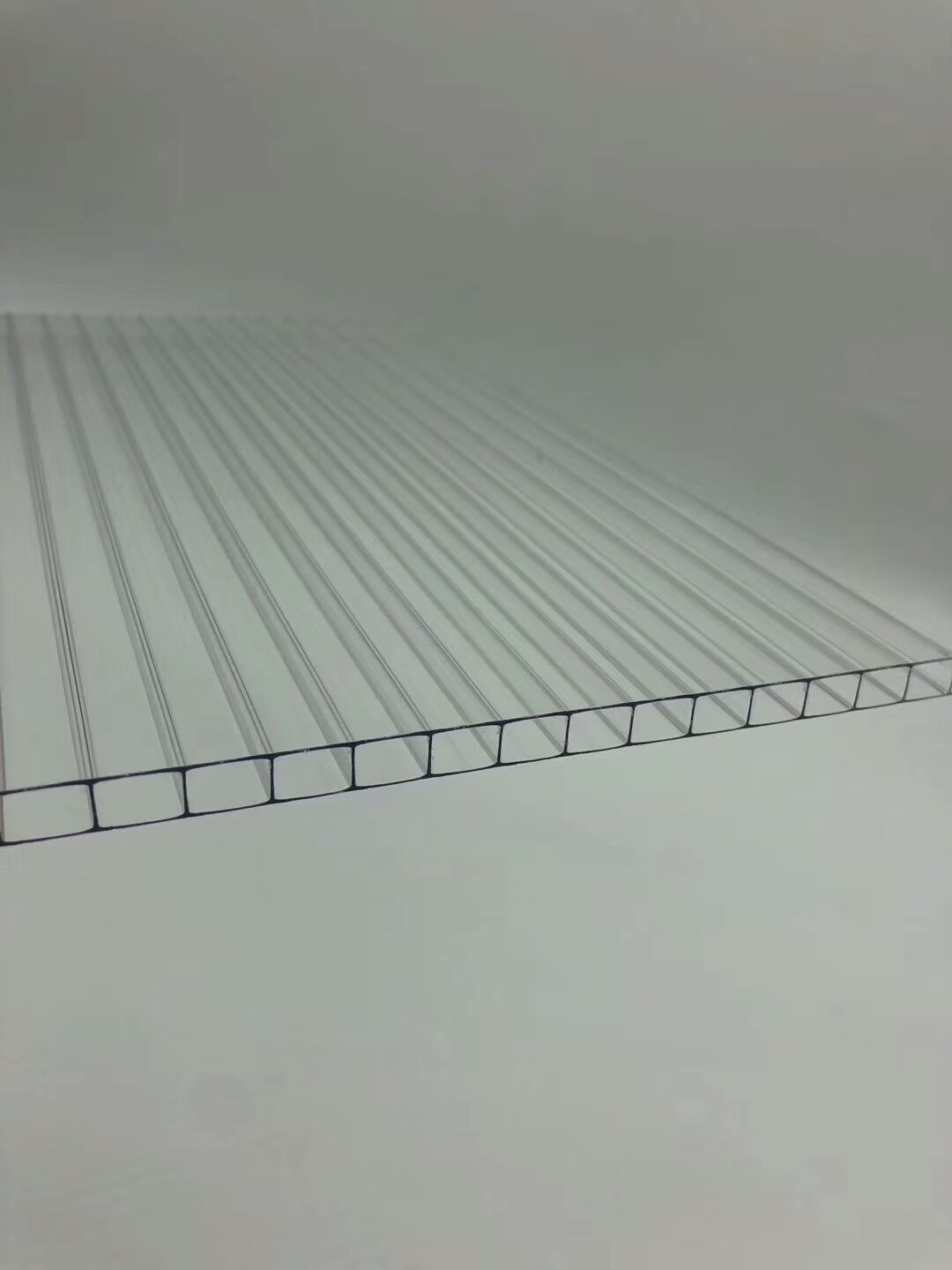
| Multiwall (hollow) sheet | B1 | V-0 to V-2 | B-s1,d0 |
| Solid sheet | B1 | V-0 to V-2 | — |
| Corrugated sheet | B1 | V-2 | — |
| Interlocking panel | B1 | V-2 | B-s1,d0 |
U-Lock roofing systems and other profiles are also available in B1 flame-retardant grades on request. Tell us the local code you must meet and we will match the grade.
UL94 V-0 vs V-2: why the difference matters
The gap between V-0 and V-2 is not about whether the sheet burns — both self-extinguish. It is about flaming drips:
- V-0: flames stop within 10 seconds after the burner is removed, and the sample produces no flaming drips.
- V-2: flames stop within 30 seconds, but burning droplets are allowed.
Flaming droplets matter because they spread fire downwards — onto insulation, stored goods or people. For overhead glazing, skylights and public buildings, specify V-0 or Euroclass B-s1,d0 (the “d0” means zero flaming droplets). V-0 is a premium flame-retardant grade and is available across our sheet range on request.
Which fire rating should you specify?
Use this quick reference to match the rating to the application and the local building code:
| Application | Recommended rating |
| Public buildings, schools, hospitals, transit | B1 + Euroclass B-s1,d0 (or UL94 V-0) |
| Factory skylights and industrial roofing | B1 + UL94 V-2 minimum |
| Greenhouses, carports, agricultural covers | B1 |
| Commercial façades and light boxes | B1 + UL94 V-0 (non-drip) |
The local code always wins: request our test certificates and data sheets, and confirm the rating with your engineer before finalising the order.
Why polycarbonate beats acrylic and PVC on fire safety
Fire behaviour is a key reason to choose polycarbonate over lookalike plastics:
- Acrylic (PMMA) ignites easily and burns with a self-sustaining flame — it is generally not rated B1.
- PVC sheet releases hydrogen chloride gas when burned, which is corrosive and toxic.
- Polycarbonate is halogen-free, self-extinguishing and low-smoke, with no acid gas release.
As a manufacturer, Jietai controls the raw-material grade in-house, so we can guarantee consistent B1 / V-0 performance from batch to batch — something you cannot always count on from a mixed-source reseller.
Frequently asked questions
Is polycarbonate sheet flammable?
No. Polycarbonate is self-extinguishing: it chars and stops burning once the flame source is removed, and it only ignites around 580 °C.
What does a B1 fire rating mean?
B1 is the “flame-retardant” class in China’s GB 8624 standard. A B1 material is hard to ignite, burns slowly when forced, and stops burning on its own when the flame is removed.
What is the difference between UL94 V-0 and V-2?
Both self-extinguish, but V-0 stops within 10 seconds and produces no flaming drips, while V-2 stops within 30 seconds and allows burning droplets. For overhead or public glazing, choose V-0.
Does polycarbonate release toxic fumes when it burns?
No halogen gases. Because polycarbonate contains no chlorine or cyanide, it does not release hydrogen chloride or hydrogen cyanide; its combustion products are low-smoke and non-corrosive.
Is polycarbonate sheet suitable for public buildings?
Yes. Multiwall polycarbonate sheet meets B1 (GB 8624) and Euroclass B-s1,d0, and solid sheet meets UL94 V-0, so both are widely accepted for schools, hospitals, transit and other public buildings once the local code is confirmed.
Need a specific fire rating for your project? Contact our team with your application and the standard you must meet — we will send the matching grade, test certificates and a quote.
Need fire-rated polycarbonate for a project?
Send us four things and we’ll come back with the right sheet type, thickness and fixing details — plus a reference project for the same application:
- What the project is — roofing, canopy, partition, skylight, or signage
- Size — sheet dimensions or total area in m²
- Quantity — sheets or square metres
- Destination country or port
Related on this site
- Acrylic Sheets — cast & extruded PMMA, 92% light transmission
- PVC Sheets — rigid & foam PVC board, chemical resistant
- Polycarbonate for Commercial Skylights — opal diffusion, U-value 2.0-3.0 W/m2K