


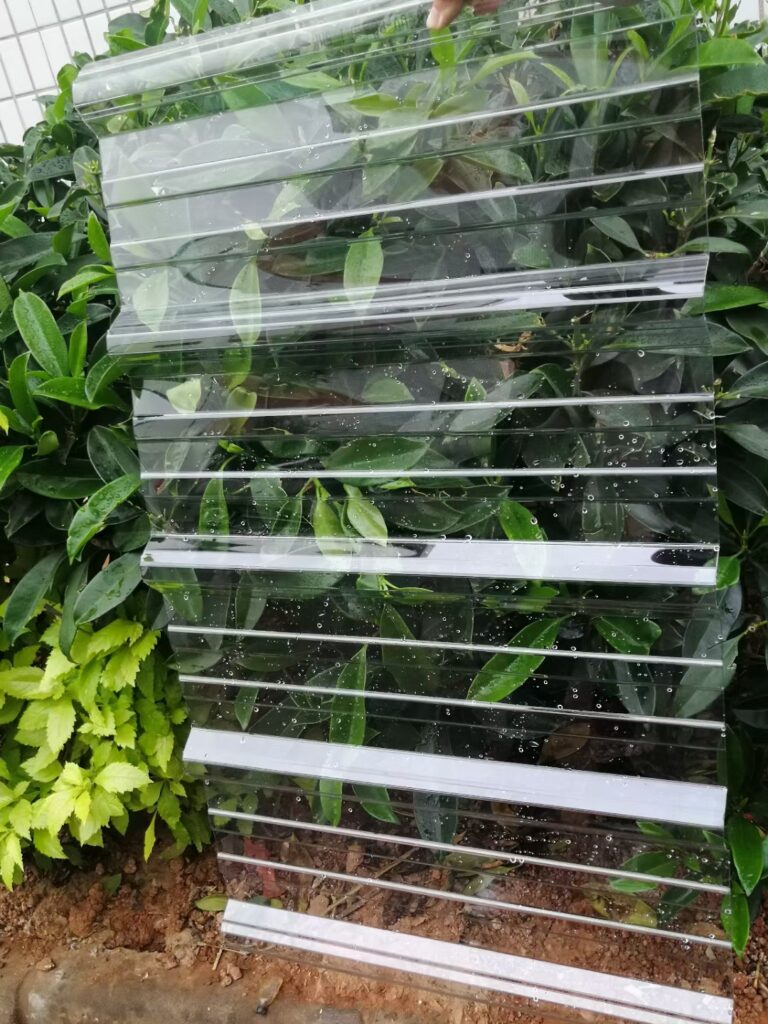
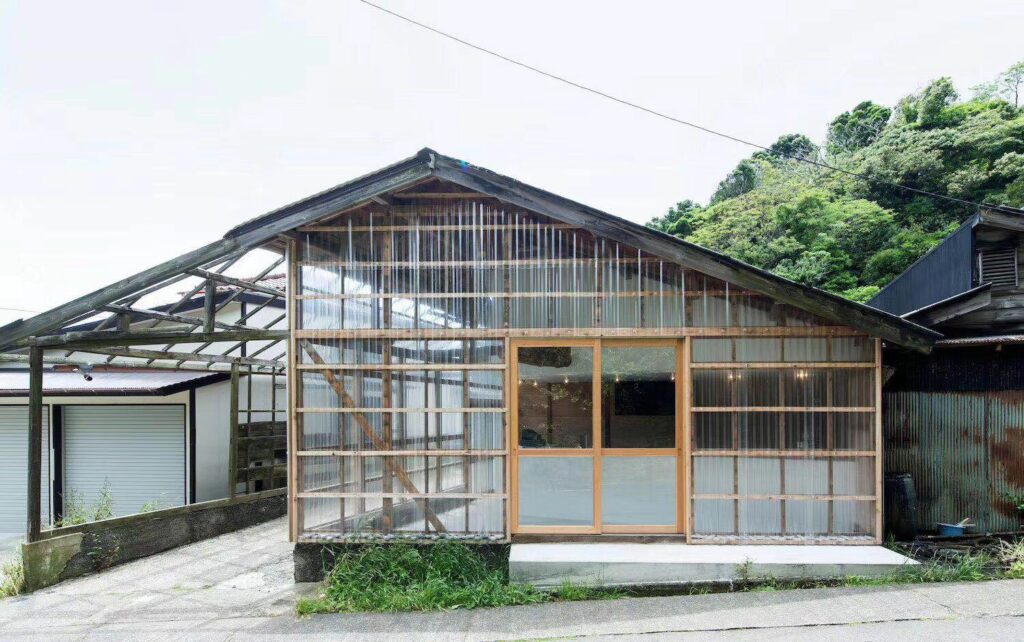
Three materials share the same corrugated geometry and the same fixing detail, so they get specified interchangeably at the drawing stage and then behave completely differently on the roof. Corrugated polycarbonate, FRP daylighting sheet and metal profiled sheet are not alternatives to each other in every position: one of them is the only one that lets light through, one of them survives chemistry that destroys the others, and one of them is what the rest of the roof is made of.
This comparison is written from the position of someone who extrudes the polycarbonate: we will tell you where our product is the wrong choice, because a roof that fails in two years costs us more than a lost order.
Corrugated Polycarbonate vs Metal vs FRP: The Comparison Table
| Property | Corrugated polycarbonate | FRP daylighting sheet | Metal profiled sheet |
|---|---|---|---|
| Light transmission | 85–90% clear | 80–90% when new | None |
| Weight | 1.0–1.5 kg/m² | 1.5–2.5 kg/m² | 4–6 kg/m² |
| Impact | Flexes, does not shatter | Brittle once aged, cracks | Dents, does not shatter |
| Ageing mode | Yellowing if UV layer is thin | Fibre bloom: resin erodes, glass fibre shows | Corrosion from cut edges and fasteners |
| Chemical resistance | Poor to solvents and alkalis | Good to ammonia, acid, alkali, salt | Depends on coating; edges vulnerable |
| Service life outdoors | 10–20 years | 10–15 years | 15–30 years |
| Repairability | Replace the panel | Replace the panel | Replace the panel or patch |
| Best position | Daylighting runs in an insulated or uninsulated roof | Daylighting where chemicals or ammonia are present | The rest of the roof |
Only One of the Three Is Transparent
This is the point that decides most projects, and it is often missed in the comparison sheets. A profiled metal roof has no light transmission at all: every square metre of roof is a square metre of artificial lighting that has to be paid for every day of the building’s life. That is why a metal roof almost always carries daylighting strips, and the strips are where this comparison actually happens.
In practice a roof is a hybrid: metal profiled sheet for most of the area, with 5 to 15% of the roof area glazed in corrugated polycarbonate or FRP at the same profile and the same fixing centres. The choice between polycarbonate and FRP then applies only to that strip, which is a much narrower question than “which roofing material should I use”.

How Each Material Ages
All three degrade, and they degrade in completely different ways. Knowing the failure mode is how you judge a supplier’s claim:
- Polycarbonate yellows. The polymer itself takes UV damage, which is why every sheet carries a co-extruded UV layer. Where that layer is thick and on the correct face, yellowing is slow and measurable in decades; where it is thin or the sheet is installed upside down, the sheet goes yellow and brittle within a few years. The failure is visible as a colour shift, not as a structural change.
- FRP blooms. The resin at the surface erodes under UV, exposing the glass fibres underneath. The sheet goes from translucent to a chalky, fibre-visible white, and light transmission drops permanently. This is called fibre bloom and it is the characteristic FRP failure, not a defect of one maker.
- Metal corrodes. Profiled steel fails at the cut edge, the fastener and any scratch through the coating. It is a slower failure and it is local, which is why metal roofs can be patched while a yellowed polycarbonate panel cannot be restored.
Published QUV accelerated weathering data makes the difference concrete. In a 100-hour QUV cycle — roughly one year of Arizona outdoor exposure — a clear polycarbonate sample held its light transmission at 91.2% and its yellowness index moved from 1.26 to 3.70. FRP samples over the same cycle dropped from about 90% to 83% transmission with the yellowness index moving from 9.9 to 27.9 for a 5 oz sheet, and worse for heavier grades. Treat those figures as direction rather than gospel: they come from supplier comparison testing, not from an independent study.
Impact and Hail
A roof is hit by things, and the three materials respond differently:
- Polycarbonate flexes under impact and recovers. It does not shatter, which is why it is used over walkways, pool enclosures and anywhere glass would be a hazard.
- FRP is stiff and, as it ages, brittle. New sheet resists hail reasonably; ten-year-old sheet cracks, and a cracked daylighting panel is a leak with no repair.
- Metal dents. A dented metal roof is a cosmetic problem and occasionally a ponding problem, not usually a leak.
Where hail is a design load rather than an occasional event, the thickness of the daylighting panel matters more than the material: 1.2 mm polycarbonate performs very differently from 0.8 mm under the same stone.
Where FRP Beats Polycarbonate
This is the part most polycarbonate suppliers leave out. FRP is a glass-fibre reinforced polyester or acrylic composite, and it resists chemistry that destroys polycarbonate:
- Ammonia and hydrogen sulphide — livestock buildings, where litter and slurry off-gas attack polycarbonate and stress-crack it.
- Acids and alkalis — chemical plants, fertiliser storage, plating lines.
- Salt spray — coastal roofs, where polycarbonate is acceptable but FRP is often preferred for chemical plants on the coast.
- Alkaline washdown — food and dairy areas cleaned with caustic agents, which is one of the fastest ways to destroy a polycarbonate sheet.
If the building is a pig shed, a sewage treatment hall or a fertiliser store, FRP is the honest answer and we will say so. Polycarbonate in those environments fails by crazing and cracking around every fixing within a few years, and no UV layer prevents it because the attack is chemical rather than photochemical.
Where Metal Wins
- Everywhere light is not wanted. Most of the roof, most of the time.
- Where the roof has to carry load or take foot traffic. Polycarbonate and FRP span between purlins; they are not a working platform.
- Where the budget is the constraint and the roof is simple. Profiled steel is the lowest first cost per square metre of the three.
- Where fire performance drives the design. Metal is non-combustible; both polymer options are classified rather than non-combustible, which matters in some compartments.
Putting Daylighting Strips into a Metal Roof
Because the real-world decision is the strip rather than the whole roof, the practical rules matter more than the material table:
- Match the profile exactly. PC760 to PC1050 exist to match standard metal profiles. A strip that does not match the wave is a leak regardless of material.
- Set the area deliberately. 5 to 15% of roof area is the usual range. Below that the space feels dark and lighting load rises; above it the roof gains heat and loses structural simplicity.
- Place the strips where the light lands. Continuous runs along the ridge give even light; scattered single sheets give patchy light and more joints.
- Lap the strip over the metal, not under it. Water has to run off the metal and onto the strip, never into the side lap.
- Accept that the two materials move differently. Polycarbonate expands roughly 0.065 mm per metre per degree; steel about a third of that. Each strip must be fixed with oversize holes and allowed to move independently, or the fasteners will work loose at the junction.
- Single-face UV. Corrugated daylighting sheet normally carries UV on the weather face only — mark the film before stripping, because an inverted sheet has no protection at all.
Where Things Go Wrong
| Symptom | Usual cause |
|---|---|
| Strips leak within a season | Profile does not match the metal; side lap reversed |
| Daylight panels crack at the fixings | Holes not oversize; strip clamped instead of allowed to move |
| Polycarbonate crazes across the whole sheet | Chemical attack from the building below, not UV failure |
| FRP goes chalky white in three years | Fibre bloom; the resin system was not specified for the exposure |
| Yellowing in under five years | Thin UV layer, or the sheet was installed upside down |
| Condensation dripping from the strips | Single-layer glazing over a humid space; a thicker sheet alone will not fix it |
Where We Are Honest About the Limits
- We sell the polycarbonate, so read this section twice. In livestock, chemical and alkaline-wash environments we will recommend FRP even though we do not profit from it.
- Our weathering figures come from comparison testing. The QUV numbers above are directionally useful and not an independent third-party study. Real service life depends on latitude, altitude, pollution and the UV layer thickness on the sheet you actually receive.
- Single-skin daylighting does not insulate. Whether it is polycarbonate or FRP, a single-layer strip has a U-value near 5.8 W/m²K. If the building is heated, the strips are a thermal bridge and a multiwall or hollow solution is the better answer.
- We cannot verify the metal on your roof from here. Send the profile reference and we will match it; we cannot confirm a wave from a photograph.
- Fire classification belongs to the assembly. Our sheets are classified as tested; the roof build-up, the fixings and the substrate are part of what an inspector assesses.
Choosing Between Them
- If the position has to transmit light, metal is out. Choose between polycarbonate and FRP.
- If the building produces ammonia, acid, alkali or gets alkaline washdown, choose FRP.
- Otherwise choose polycarbonate, for impact resistance, weight and clarity.
- Set the daylighting area deliberately (5–15%) and run it in continuous strips.
- Match the metal profile exactly and fix the strip so it can move.
Send us the metal profile reference, the roof area and the building type through our contact form, and we will come back with the strip specification and a quotation. If the building is one where FRP is the better material, we will tell you that instead — the closer comparison between polycarbonate and FRP goes into the UV data in more depth, and the corrugated polycarbonate product page has the profile and thickness range for the strips themselves.
Frequently Asked Questions
Is corrugated polycarbonate better than FRP for a roof?
It depends on the building, not the sheet. Polycarbonate wins on impact resistance, weight and clarity, and is the better choice for most industrial and commercial roofs. FRP wins where ammonia, acid, alkali or alkaline washdown are present, such as livestock buildings, chemical plants and food processing, because polycarbonate stress-cracks under those conditions.
Can I use corrugated polycarbonate for the whole roof?
You can, and some canopies are built that way, but most roofs use metal for the area and 5 to 15% polycarbonate as continuous daylighting strips. Single-skin polycarbonate has a U-value near 5.8 W/m2K, so a fully glazed roof over a heated building is a thermal problem.
How long does corrugated polycarbonate last outdoors?
Ten to twenty years for a sheet with a proper co-extruded UV layer installed the right way up. Thin UV layers and inverted installation are the two ways that becomes three to five years, and the failure shows as yellowing and embrittlement rather than a gradual change.
Why does FRP turn white and chalky?
Because the resin at the surface erodes under UV and exposes the glass fibres underneath. This is called fibre bloom and it is the normal ageing mode of FRP, not a defect of a particular manufacturer. Light transmission drops permanently as it progresses.
Does a metal roof need daylighting strips?
It does not strictly need them, but without them every square metre of roof is a square metre of artificial lighting for the life of the building. The usual specification is 5 to 15% of roof area in continuous strips, matched to the metal profile and fixed so the strip can move independently.
What is the most common mistake with daylighting strips?
Using a profile that does not match the metal, or fixing the strip rigidly. A mismatched wave leaks at the side lap, and a strip that cannot move cracks at the fixings as it expands. Both problems look like a material failure and are actually a specification failure.
Send your metal profile and roof area
Tell us the metal profile reference, the roof area and what the building is used for, and we will confirm the daylighting strip specification and send a quote — or tell you if FRP is the better material for that environment.
- Send profile reference, roof area and building type
- We confirm the strip material, thickness and percentage
- You receive the quote with fasteners and closures