
FRP and polycarbonate skylight sheets look almost identical on a roof. Both are corrugated, both come in the same wave profiles that match steel cladding, and both let daylight through. Fifteen metres away you cannot tell them apart — which is exactly why buyers substitute one for the other without checking, and why roofs fail 18 months later for reasons nobody can explain from the ground.
This comparison is written from the two materials’ failure modes rather than from a feature list. If glass and acrylic are also in the frame, our four-material comparison covers those. It covers what each sheet is actually made of, how each one ages under ultraviolet light, where FRP is genuinely the better choice, and the cases where the decision has nothing to do with the material at all.
What Each Sheet Is Made Of
A polycarbonate skylight sheet is a thermoplastic: polycarbonate resin extruded into a corrugated profile, usually with a co-extruded UV layer on the weather face. It can be re-heated, re-formed and recycled. That is why it can be cold-bent on site and why an offcut can go back into a granulator.
An FRP sheet — fibre-reinforced plastic, also sold as GRP or fibreglass — is a thermoset composite: glass fibre reinforcement in an unsaturated polyester resin, formed into the profile while the resin cures. Once cured it cannot be melted or re-formed. Cut it and the cut edge shows fibre, not plastic.
That single structural difference drives everything else. PC behaves like a tough plastic; FRP behaves like a thin rigid laminate. Fixings, thermal movement, impact response and repair method all follow from it.

How Polycarbonate Skylight Sheets Age Compared With FRP
New sheets of both materials transmit a similar amount of light. Ten years later they do not. Accelerated weathering testing on identical corrugated profiles shows the divergence clearly:
| Material | Light 0 h | Light 1000 h | YI 0 h | YI 1000 h |
|---|---|---|---|---|
| PC, clear | 91.2% | 91.2% | 1.26 | 3.70 |
| FRP 5 oz, brand A | 90.3% | 83.3% | 9.89 | 27.88 |
| FRP 8 oz, brand A | 85.8% | 76.6% | 15.10 | 30.45 |
| FRP 5 oz, brand B | 90.5% | 83.8% | 7.17 | 19.47 |
| FRP 8 oz, brand B | 83.5% | 80.1% | 12.61 | 26.97 |
In this test 100 hours of QUV exposure is roughly equivalent to one year of outdoor exposure in Arizona, so 1000 hours is roughly a decade. The yellowing index (YI) is the number to watch: PC starts near 1 and stays under 4, while FRP starts between 7 and 15 and climbs to between 19 and 30.
Two caveats, stated plainly. This dataset comes from a polycarbonate manufacturer’s comparative weathering test, not from independent academic research — read it as direction, not as gospel. And FRP does not fail by turning brown the way an unprotected PC sheet does. It fails by fibre bloom: the surface resin erodes under UV and moisture, glass fibres become exposed, and the sheet goes chalky, rough and dull. Once the surface has bloomed, light transmission falls and cleaning speeds it up.
Polycarbonate’s equivalent weakness is its UV layer. The resin underneath will yellow if that layer is worn through by abrasion or attacked by the wrong cleaner. The material is not the issue; the surface protection is, which is why the warranty is written against the coating rather than against the sheet.
Impact, Hail and Whether It Can Be Walked On
Polycarbonate wins impact by a wide margin. It is a ductile material — a falling-dart test on multiwall sheet records energy absorption in the range of tens to hundreds of joules without rupture, and it does not shatter into fragments. In hail country, or anywhere a roof is exposed to wind-borne debris, that is the deciding property.
FRP is a thin rigid laminate. It handles normal handling and foot traffic loads across supports, but a hard concentrated impact — a large hailstone, a dropped tool, a thrown object — produces a crack or a puncture, and the broken edge delaminates and splinters.
Neither material is a walking surface. Both are installed across purlins and neither should be stepped on between supports. Where a roof needs to be trafficked, that is a fall-protection system question, not a sheet question.

Chemical Exposure: Where FRP Genuinely Wins
This is the case for FRP, and it is a real one. A cured polyester composite resists ammonia, acids, alkalis and salt-laden air far better than polycarbonate does. Polycarbonate is attacked by ammonia and by many alkaline cleaners, and stressed polycarbonate will craze and crack in those environments over time.
So the applications where FRP is the better specification are specific and predictable:
- livestock and poultry buildings, where ammonia from litter is continuous
- wastewater treatment and pump stations, where hydrogen sulphide and moisture combine
- fertiliser and chemical plant roofs, and coastal installations
- buildings where the roof will be washed down with alkaline detergents
If the roof sits over livestock, and the client asks why not polycarbonate, the honest answer is that it can work — but the ammonia exposure has to be ventilated away from the underside, and the sheet has to be specified for it. Saying “use FRP here” is usually the shorter and more reliable answer.
Weight, Thermal Movement and Fixing Detail
Polycarbonate is roughly 40% lighter than an FRP sheet of the same profile and thickness, which reduces purlin and frame demand on a large roof. It also moves considerably more: a coefficient of linear expansion around 0.067 mm per metre per °C means a 6 m sheet changes length by roughly 4 mm across a 10°C swing.
That movement is not a defect, but it dictates the fixing detail. Every hole is drilled 2–3 mm oversize, positioned clear of the sheet edge, and the screw is tightened only until the washer contacts the sheet. A rigidly clamped polycarbonate roof cracks at the fixings within a season or two.
FRP moves less, but it is brittle at the fixing point. Over-tightening a screw through an FRP sheet crushes the laminate locally and starts a star crack that runs with thermal cycling. Both materials want an EPDM-bonded washer, a pre-drilled hole and a screw that is snug rather than tight — the reasons differ, the discipline does not.
Fire Behaviour
Polycarbonate ignites at a high temperature — published figures sit around 580°C — and standard grades achieve B1 or Class B-s1,d0 classifications depending on thickness and system. It does melt and drip when it burns, which matters for some approvals.
FRP’s fire performance is entirely a function of its resin system. An ordinary orthophthalic polyester laminate will burn; an isophthalic or properly fire-retardant resin system with a filled laminate will not sustain flame. Two sheets both described as “FRP” can therefore have completely different fire classifications.
Practical consequence: never accept “FRP” as a fire specification. Ask which resin system, which laminate weight, and which classification to which standard — and get it in writing against the project’s requirement.
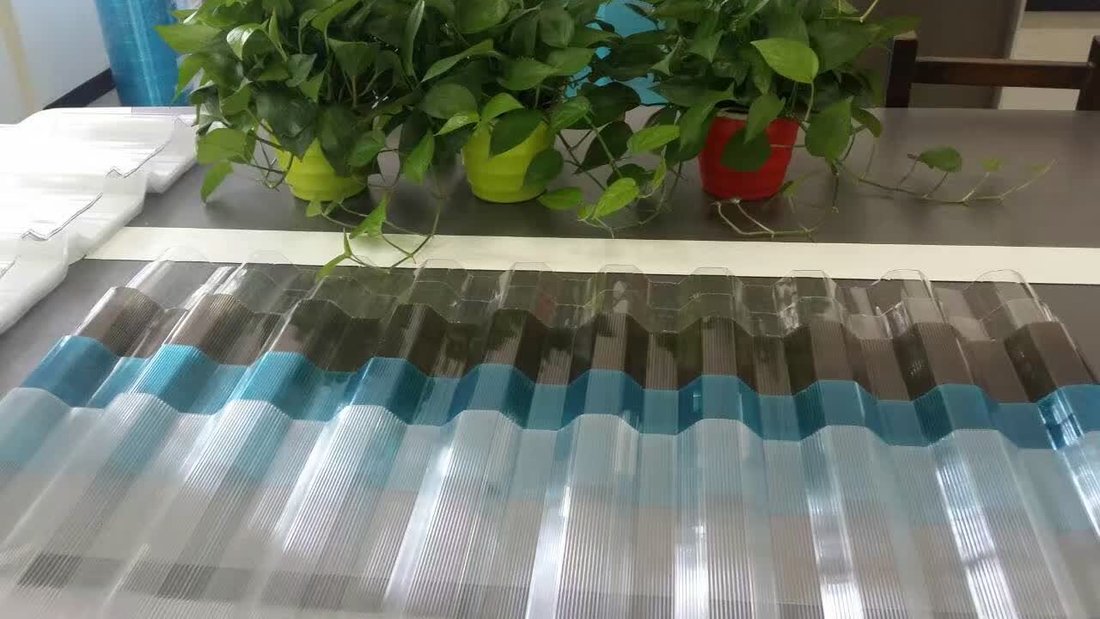
FRP vs Polycarbonate: Which One Belongs on Your Roof
| Situation | Recommendation | Why |
|---|---|---|
| Hail or impact exposure | Polycarbonate | Does not shatter |
| Livestock, wastewater, coastal | FRP | Resists ammonia and salt |
| Greenhouse, maximum light | PC with anti-drip | 91% transmission, film not drip |
| Need diffuse, glare-free light | Either, opal grade | Both diffuse when pigmented |
| Light sub-frame, long spans | Polycarbonate | About 40% lighter |
| Tight initial budget | FRP | Smaller initial outlay |
| Long life, unchanged clarity | PC, UV-protected | Yellowing stays low |
| Chemical wash-down | FRP | Tolerates alkaline cleaners |
Note what this table does not say. It does not say polycarbonate is the better material — it says the two materials win in different places, and that most specification errors come from choosing by appearance or by one number.
Where We Are Honest About the Limits
- FRP beats us on chemical resistance. On a livestock or wastewater roof, an FRP sheet is the technically correct choice, and we will say so instead of arguing for our own product line.
- Polycarbonate needs a bigger initial budget. The gap narrows when replacement and maintenance are counted, but the first invoice is larger.
- PC will crack if it is clamped. Almost every premature failure we see is a fixing detail, not a material fault — oversize holes and a free-running washer are not optional.
- Most skylight leaks are detail failures. Wrong lap direction, insufficient end overlap, incompatible sealant or a hole drilled on site with no allowance. Neither material survives bad detailing.
- UV protection has a service life. Both families depend on a surface layer or resin system that degrades; the warranty tracks that layer, not the polymer underneath.
What to Tell Us Before You Order
- What is under the roof — people, crops, livestock, chemicals, stored goods.
- Wave profile you need to match, and the purlin spacing on the existing frame.
- Hail, wind or snow exposure at the site.
- Whether the underside will be washed, and with what.
- Any fire classification the building approval requires, and against which standard.
Send those through our contact form and we will tell you which of the two we would put on that roof — whether that is a polycarbonate skylight sheet or FRP — including the cases where the answer is FRP rather than our own corrugated polycarbonate. If you are comparing quotes from two suppliers, send the sheet specs and we will point out where the two offers actually differ — that comparison is usually more useful than the number on the page.
Frequently Asked Questions
Can FRP and polycarbonate sheets be mixed on the same roof?
Yes, provided the wave profiles match and each material is fixed with its own allowance for movement. The two expand at different rates, so a sheet of each cannot share a rigidly clamped fixing line. Mixing is common where a roof needs chemical resistance at one end and impact resistance at the other.
Why has my FRP sheet gone white and fuzzy?
That is fibre bloom. The surface resin has eroded under UV and moisture, exposing the glass fibres underneath. It is not dirt and it does not clean off. Once the surface has bloomed, light transmission drops and the sheet is approaching the end of its service life.
Which is better for a greenhouse, FRP or polycarbonate?
Polycarbonate, in a clear or diffused grade with an anti-drip face. It transmits more light, ages without blooming, delivers better insulation in a multiwall profile, and the anti-drip surface keeps condensate from dripping onto the crop. FRP’s advantage is chemical resistance, which a greenhouse does not usually need.
Does polycarbonate really yellow over time?
The polymer does not yellow while its UV layer is intact. Failures come from the layer being worn through by abrasion, attacked by an unsuitable cleaner, or never specified on both faces where both are exposed. A UV-protected sheet keeps its clarity for decades; an unprotected one does not.
Can I walk on a polycarbonate or FRP skylight sheet?
No. Both are designed to span between purlins and neither is a walking surface. Where a roof must be accessed, use crawling boards that span at least three supports, and where fall protection is regulated, specify a tested system rather than relying on the sheet.
Is FRP the cheaper option?
FRP usually asks for the smaller initial outlay on the same profile, so it wins on first cost. Whether it wins over the life of the roof depends on the exposure: in a chemical or coastal environment it often does, and on a hail-exposed roof where it will crack it often does not.
Compare the specification, not the picture
Send your roof details and request a quote with the sheet, profile and fixing detail for your site — we will tell you where polycarbonate is the right answer and where it is not.
- Tell us what sits under the roof and the exposure
- We recommend PC or FRP with the reason
- You receive a sample and a quotation