
Two suppliers quote the same job. Both panels are described as 9 mm white PVC wall panel, tongue and groove, 400 mm wide. One price is almost double the other. The buyer assumes one of them is either padding the quote or cutting corners somewhere invisible.
Usually neither. The gap sits in two places that a spec sheet rarely records: the finish system on the face, and the internal section of the core. Everything else — thickness, width, colour name, edge profile — can be identical while those two are not. This is why comparing PVC wall panel offers by thickness alone is the most common sourcing mistake in the category.
A PVC Wall Panel Is Two Products Stacked Together
A wall panel is not one material. It is a structural core with a decorative system bonded on top, and the two are manufactured by completely different processes.
The core is extruded: PVC compound is pushed through a die that forms the outer faces, the internal webs, and the tongue and groove edge in a single pass. Its job is stiffness, flatness over the panel length, and dimensional stability. The finish is applied after extrusion and consists of several thin layers — a tie coat for adhesion, a decorative layer carrying the wood grain or stone pattern, and a protective topcoat. Its job is to look right and to survive cleaning.
Buyers usually scrutinise the core because it is measurable, and accept the finish because it photographs well. In service it is the reverse: finishes fail long before cores do. A printed face that chalks or peels is what generates the complaint, not a web that is 0.1 mm thinner than another supplier’s.
Four Finish Routes and What Each One Survives
Almost every PVC wall panel on the market uses one of four finish routes. They are not quality tiers of the same thing — they are different products with different failure modes and very different cost positions.
| Finish route | How it is applied | Where it holds | Where it fails |
|---|---|---|---|
| Direct print | Pattern printed straight onto the face | Dry interior walls, low-traffic rooms | Wears through at hand height; yellows without a topcoat |
| Hot stamping | Metallic or transfer film pressed on with heat | Ceilings and decorative accents | Thin layer; abrades at edges and corners |
| Laminated film | PVC, PET or PP film bonded under heat and pressure | High-traffic walls, wet areas, textured wood looks | Delaminates if the adhesive bond fails |
| UV topcoat (on any of the above) | Liquid acrylate rolled on, cured instantly under UV lamps | Walls that get wiped daily | Can chip under sharp impact |
The practical distinction is hardness versus toughness. A UV-cured topcoat produces a dense cross-linked shell with a pencil hardness typically in the 2H to 4H range, and abrasion resistance around 2,000 to 4,000 Taber cycles. Keys, trolley corners and cleaning equipment slide off it. It is also brittle: a sharp, hard impact can chip the coating and leave a white mark that cannot be polished out.
A laminated film behaves the opposite way. The film is softer and absorbs impact without cracking, but a sharp metal edge can cut into it where it would slide off a UV surface. Higher-grade films add a transparent wear layer over the print, which narrows that gap considerably.
The reason laminated film commands a higher price is not only durability. It is the only route that produces a deep, synchronised texture — where the embossed grain physically follows the printed grain direction. A flat printed face reads as plastic from two metres away; a synchronised film reads as timber. That is a design decision, and design decisions cost money.
Film Polymer: PVC, PET or PP
When a supplier says laminated PVC wall panel, the film itself may still be one of three polymers, and the choice changes gloss, colour life and chemical behaviour more than the film thickness does.
PVC film is the default. Density around 1.35 to 1.45 g/cm³ makes it the heaviest of the three at equal thickness, but it accepts deep embossing and synchronised registration better than the others, which is why most high-gloss marble-look and softly textured wood-look panels use it. PET film wins on abrasion and heat resistance. PP film gives a warm matte surface at lower cost and suits projects with single-polymer recycling requirements.
Film thickness in panel lamination commonly runs from about 0.08 mm to 0.35 mm. Within that band, thicker film buys abrasion life; the polymer family sets the chemical and thermal behaviour. Neither number appears on most quotations, which is exactly why two apparently identical panels can differ by a third on price.
The Core Section: Hollow, Solid and Foam
Three core families are sold as PVC wall panel, and the label alone does not rank them.
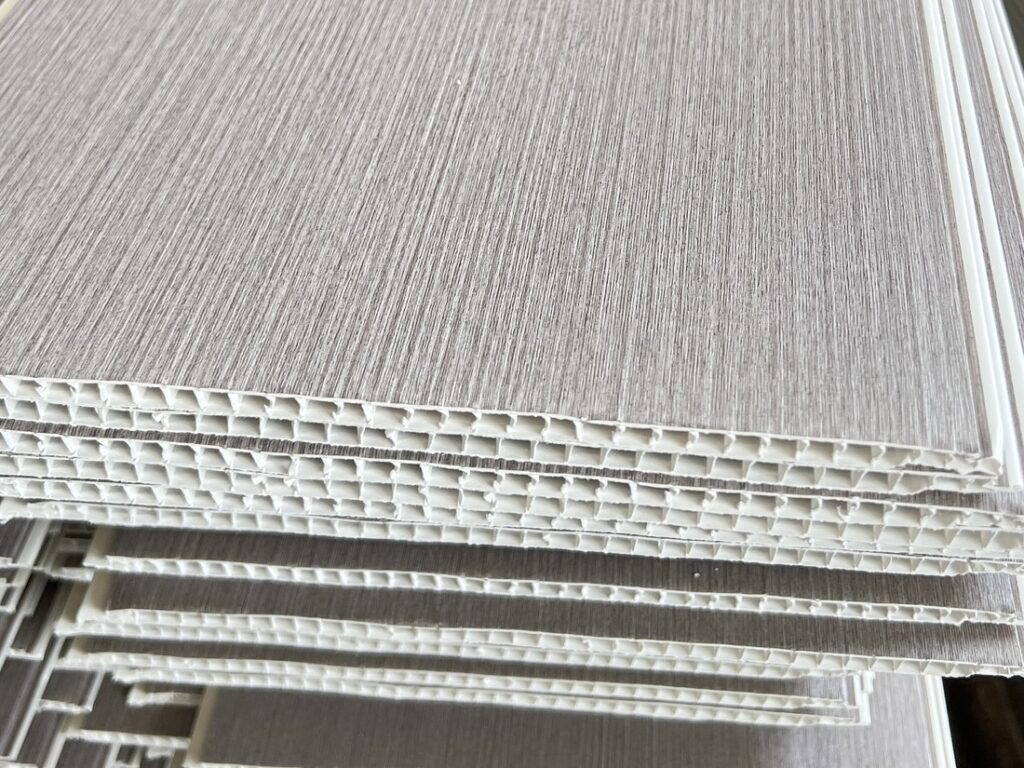
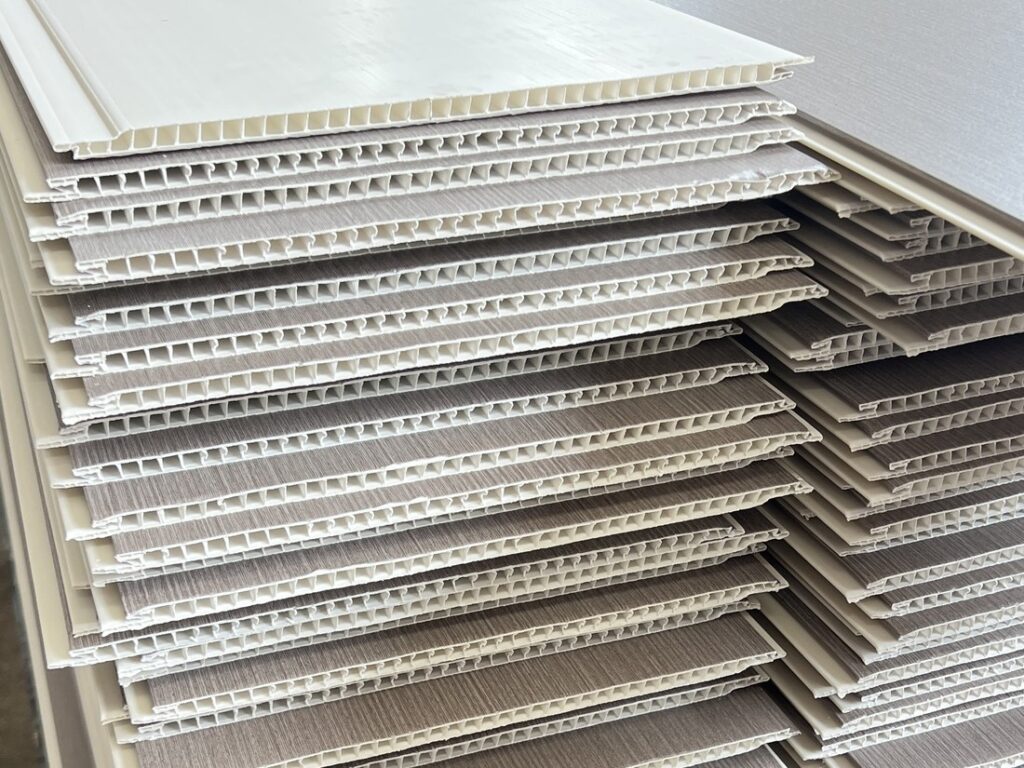
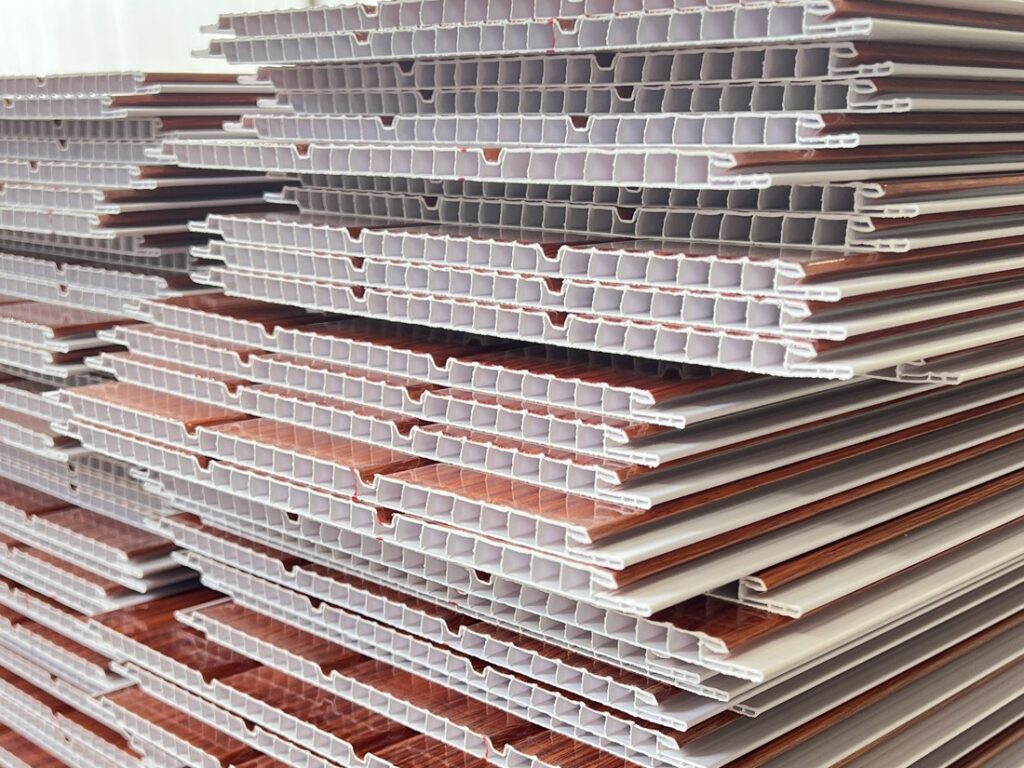
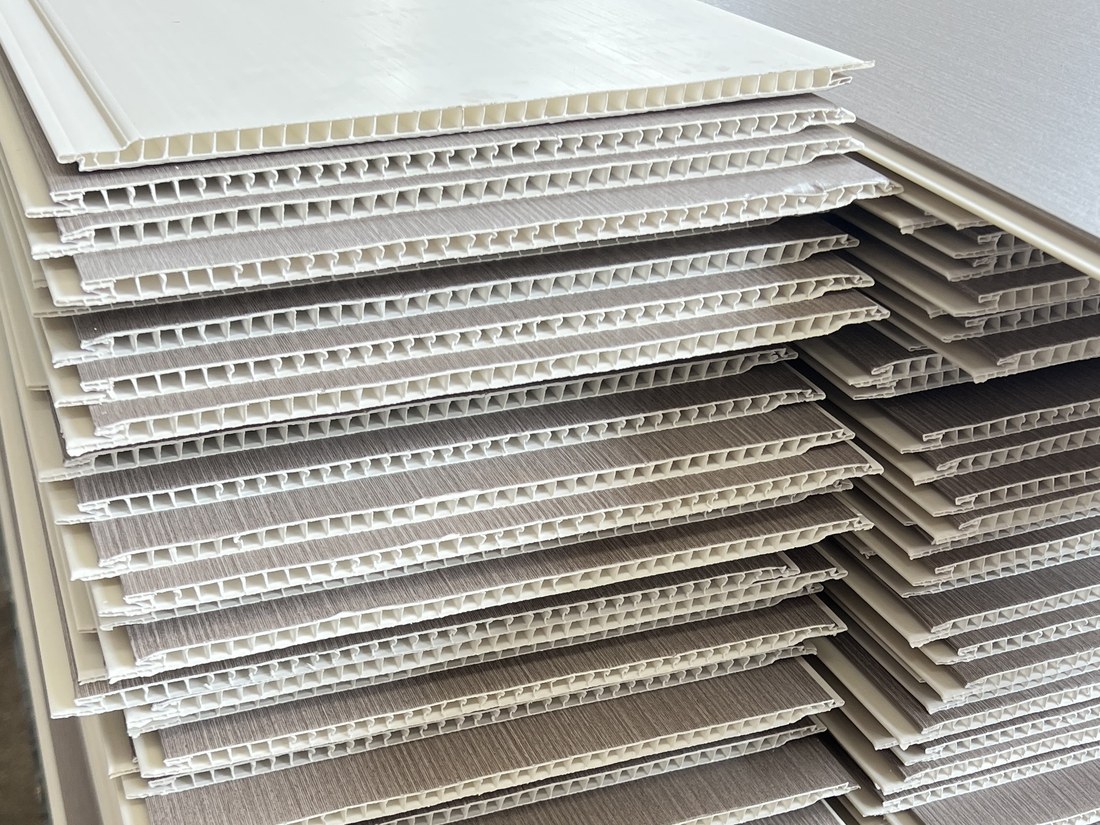
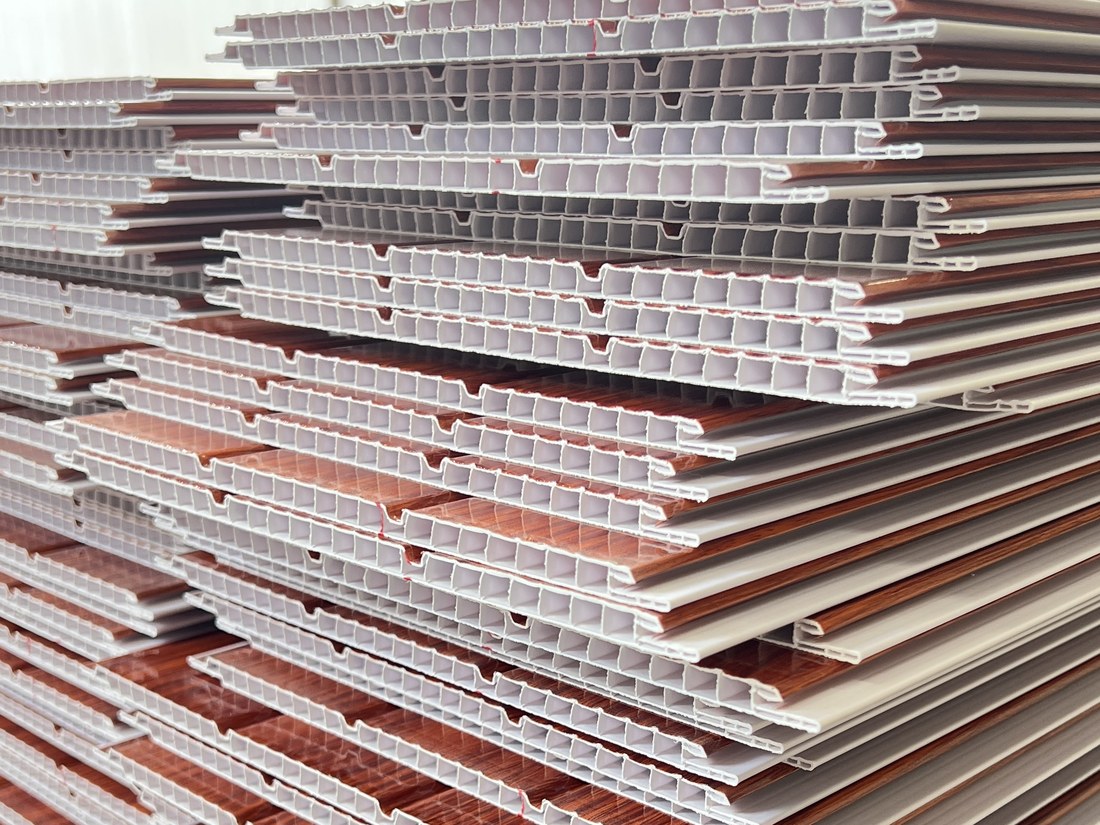
Hollow core is the mainstream construction: two rigid faces separated by internal webs, forming closed chambers. It keeps weight low — typically 3.5 to 4.2 kg/m² at 8 mm and 4.0 to 4.5 kg/m² at 9 mm — which is what allows a single installer to lift a 2.7 m length into place. The chamber layout also creates an air gap against the substrate, which helps on a cold external wall.
Solid core is a continuous profile with no intentional chambers. It is heavier and takes fixings differently, but it is not automatically stiffer — a well-designed hollow section can outperform a poorly designed solid one in bending.
Foam core uses a cellular internal structure. It is light and machines cleanly, but foam density and uniformity vary widely between suppliers, and the skin-to-core relationship has to be specified rather than assumed.
Within the hollow family, the variables that actually matter are face wall thickness, web thickness, web spacing and chamber shape. A 6 mm square-hole profile with webs on 150 mm centres behaves nothing like a multi-chamber profile of the same outside thickness. Loads travel through the webs; the outer dimension tells you almost nothing about that path.
Density Numbers That Cannot Be Compared
Density is the number buyers ask for first and understand last. For a hollow PVC wall panel there are two completely different values that both get called density.
Compound density describes the solid PVC material only, measured by displacement. It typically sits around 1.4 g/cm³ for rigid PVC and is a property of the formulation. Profile density divides the panel mass by the whole outside volume — including the air inside the chambers. That figure commonly lands between 0.5 and 0.7 g/cm³ for a hollow profile, and it tells you about the section, not the material.
Quoting one as if it were the other makes a panel look dramatically lighter or denser than it is. Before comparing two offers, establish which definition each supplier used, and ask whether the specimen and method match the profile being supplied.
A more reliable comparison is mass per covered square metre, measured on the actual panel length and the usable coverage width — the width after the tongue engages the groove, which is always less than the overall width. Using the overall width makes any panel look lighter per square metre than it really is.
What Actually Drives the Cost
Six items explain nearly all of a price difference between two PVC wall panel offers of the same nominal size. None of them is thickness.
- Finish route. A direct print and a synchronised laminated film with a UV topcoat are different products, not different grades of the same product.
- Film polymer and thickness. PVC, PET and PP sit at different cost points, and film thickness across the 0.08 mm to 0.35 mm band changes both wear life and price.
- Core compound. Virgin PVC compound versus compound containing regrind affects both cost and consistency of colour and strength.
- Section design. More webs, thicker faces and taller chambers use more material per metre. This is the single largest driver inside the core.
- Colour and batch size. A short run in a non-standard colour carries setup cost that a container of white does not.
- Packing and loading. Film-wrapped bundles and cartons differ in cost, and how efficiently panels load into a container changes landed cost more than most buyers expect.
How to Check a Sample in Ten Minutes
A physical sample answers more than a specification sheet, provided you look at the right places. Four checks cover most of the risk.
Cut the end and read the section. Count the webs, note the spacing and measure the face thickness with a caliper. Compare it with the drawing, not with the outside thickness. A section drawing that is not dimensioned is not a specification.
Try to lift the film at an edge with a fingernail. A properly bonded laminate resists; a poorly bonded one lifts. Delamination starts at edges and cut ends, which is where a wall panel is handled most.
Scratch the face with a coin at an inconspicuous corner. A UV topcoat should resist; a bare print will mark immediately. This single test separates the two most common finish routes without any equipment.
Weigh one panel. Mass per covered square metre is the one number that cannot be argued with, and it exposes both section design and compound choice at once.
Where PVC Wall Panels Are the Wrong Choice
Being straight about the limits saves a project from the wrong material.
Fire performance has a ceiling. PVC is a thermoplastic. Panels commonly reach EN 13501-1 Class B-s2,d0, which suits most interior lining work, but a project that specifies a mineral-board class should use mineral board. No finish upgrade changes the polymer’s fire behaviour.
It covers damp, it does not cure it. A panel fixed over a wet substrate traps the moisture. In a wet room the waterproofing belongs behind the panel, not on its face.
Heat sources are out. Steam in a bathroom is fine. The wall directly behind a sauna heater or an exposed flue is not — the profile softens.
The finish is a printed or laminated layer. It survives normal cleaning, but abrasive pads and solvent cleaners dull or bleach it. When that happens it is wear, not a manufacturing defect.
Frequently Asked Questions
Is a thicker PVC wall panel always stronger?
No. A 9 mm hollow profile with close webs can be stiffer in bending than a 10 mm profile with fewer webs and thinner faces. Compare the section drawing and the mass per square metre, not the outside thickness alone.
Which finish should go on a wall in daily use?
A laminated film with a UV-cured topcoat. The film absorbs impact and carries the texture, and the topcoat gives the surface 2H to 4H pencil hardness for daily wiping. A direct print belongs on low-traffic walls and ceilings.
Why do two PVC wall panels of the same colour look different on site?
Because a printed finish is a batch. If the print lot changes mid-container, one wall can read as two walls under raking light. Approve a physical sample from the exact production lot that will ship, and keep the lot reference on the packing list.
Can the same panel be used on ceilings?
Usually yes, and lighter hollow sections are often preferred overhead. What changes is the fixing: ceiling panels need support at closer centres because they carry their own weight without a wall behind them, and the expansion gap at every edge still applies.
What information is needed for an accurate quotation?
Four things: the application and room type, the wall dimensions and height, the quantity, and the destination country. With those we can recommend a section and a finish route and quote against the real configuration rather than a nominal one. The specification detail behind joints and fixing is covered in PVC wall panel joints and tongue and groove fixing, and the broader dimensional background in PVC wall panel specifications and installation.
For the full range of sections and finishes, see PVC wall panels.
Send Us Your Wall Dimensions and Get a Section Recommendation
Send the room type, wall height, total area and destination country, and we will come back with a request-specific recommendation on section, finish route and packing — with the dimensions and tolerances written down rather than assumed.