
PVC wall panel is the interior wall lining for wet rooms. It is a foamed or co-extruded PVC board with a printed decor face, installed with a click-lock joint or adhesive beads, and it is genuinely waterproof rather than water resistant. Where bamboo-wood panel stops at the shower door, this product goes inside the shower: bathrooms, kitchens, laundry areas, commercial washrooms and anywhere the wall gets hosed or wiped daily.
Request a Quote Ask for Free Samples
This page covers the thickness and width range, how panel thickness relates to substrate condition, the comparison with tile and bamboo-wood panel, wet-area installation rules, and what to specify for a quotation. Board specification and installation sequence are in the PVC wall panel specification guide, the joint detail in tongue and groove joints, and everything published on this range is indexed in the PVC wall panel articles.
PVC Wall Panel Specifications
Range at a glance
| Thickness | 5 / 8 / 10 mm |
|---|---|
| Panel width | 250 / 300 / 400 / 600 mm |
| Panel length | 2.4 / 2.6 / 2.7 m |
| Material | Foamed PVC or co-extruded PVC with decor film |
| Joint | Tongue and groove click-lock |
| Installation | Adhesive beads direct to wall, or on battens |
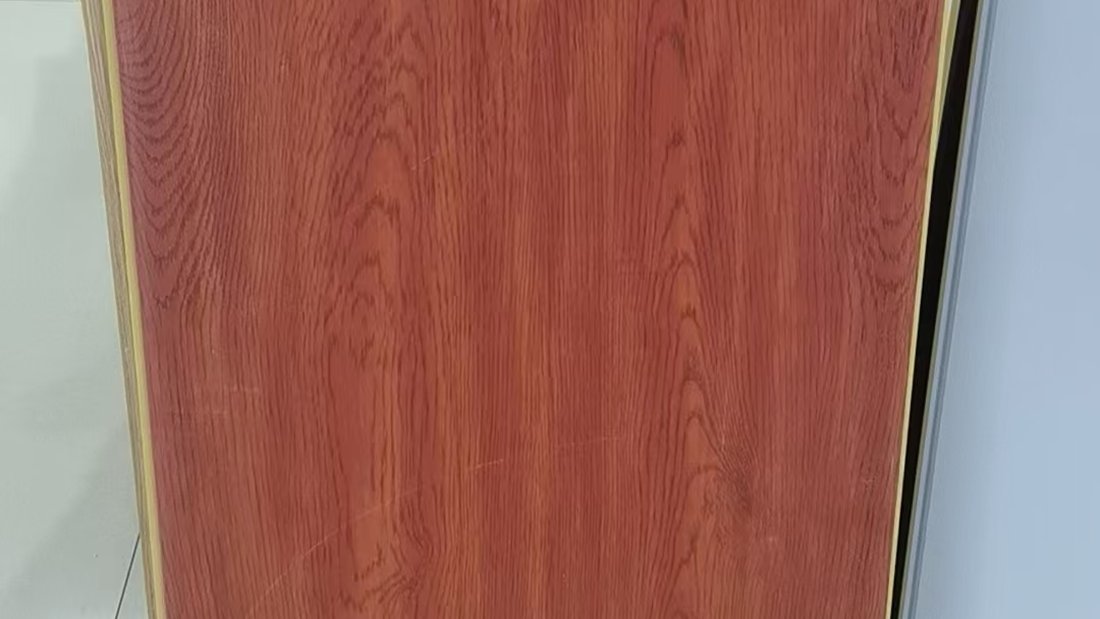
| Decors | Marble, stone, wood grain, solid colour, high gloss |
| Water | Waterproof board; sealed joints required in wet zones |
| Fire | B1 to GB 8624 on specified build-ups |
| Cleaning | Damp cloth, neutral detergent; no abrasives or solvents |
| Minimum order (MOQ) | 1 × 20GP container — mixed profiles and colours accepted |
Thickness, Width and What They Decide
| Thickness | Behaviour | Where it fits |
|---|---|---|
| 5 mm | Flexible; follows minor wall irregularities | Direct bond over an existing finish, renovation, small rooms |
| 8 mm | The general-purpose wall grade | Bathrooms, kitchens, commercial washrooms |
| 10 mm | Stiffer; conceals more substrate variation | Large panels, walls with some deviation, high-traffic areas |
Width matters more than most buyers expect. Narrow panels at 250 to 300 mm give a traditional panelled rhythm and are easier to handle on a small job; 600 mm panels reduce the number of joints on a large wall, which is where water gets in. On a commercial washroom we would normally specify the widest panel the handling allows and put the saving into the joint sealing.
PVC Wall Panel vs Tile vs Bamboo-Wood
| Property | PVC wall panel | Ceramic tile | Bamboo-wood panel |
|---|---|---|---|
| Waterproof | Yes, board is waterproof | Yes, with correct substrate | No; water resistant only |
| Joint line | Click-lock, near-invisible | Grout line, needs sealing in wet areas | Click-lock |
| Installation | Dry, one day, no wet trade | Wet trade, adhesive and grout, days | Dry, one day |
| Grout maintenance | None | Grout discolours and needs re-sealing | None |
| Look | Printed marble and stone, convincing at distance | Genuine stone or ceramic | Wood and stone effects |
| Impact | Resists knocks; deep impact dents | Can crack a tile | Scuffs and dents more easily |
| Best room | Bathroom, kitchen, laundry, washroom | Bathroom, kitchen, wet floors | Living, bedroom, office |
The honest summary: tile still wins where a genuine stone or ceramic surface is the design intent, and it is more impact resistant. PVC panel wins on installation time, on having no grout to maintain, and on renovation over an existing finish without stripping it back. Where the wall is dry, bamboo-wood panel gives a better wood look; where it is wet, this is the product.

Wet Area Installation Rules
- Seal the joints, not just the board. The panel is waterproof; the joint and the cut edge are the weak points. Use the matching joint strip and a neutral-cure sealant in a shower enclosure.
- Seal the bottom edge above a bath or tray. The single most common failure is water tracking down behind the panel at the tray junction; the bottom edge needs a seal and a gap, in that order.
- Battens create a service void. Where the wall is out of tolerance or pipes run behind it, battens give a true plane and 25 to 50 mm of void — worth it in a bathroom.
- Leave a movement gap of 3 to 5 mm at top and bottom, closed with trim. PVC moves with temperature more than you would expect on a long wall.
- Around outlets and mixers. Cut from the back, keep the decor film intact, and seal the penetration. A silicone bead around a shower mixer is not optional.
- Never use solvent-based sealant or cleaner on a foamed PVC board; it attacks the surface.
Supply, Decors and Container
- Decors. Marble, stone, wood grain, solid colour and high gloss; batch matching on volume, one batch per room for a continuous wall.
- Trims. Internal and external corners, end caps, joint strips and skirting in the same decor — specify them with the panels.
- Packing. Light and bulky: a container cubes out long before it weighs out, so plan by volume rather than tonnage.
- Spares. Hold 3 to 5 % in the same batch, and a spare length of joint strip; matching a printed marble decor from a later run is not reliable.
Where We Are Honest About the Limits
- It is a printed surface. The marble and stone decors look convincing at normal viewing distance and they are not stone. Deep scratches cannot be polished out the way a tile can be.
- It dents. Foamed PVC resists knocks better than plasterboard and less well than tile. A hard impact leaves a mark that cannot be repaired locally.
- Waterproof board, waterproof wall — only if the joints are sealed. The board will not swell, but an unsealed joint or an unsealed tray junction lets water behind it, and the failure shows up as mould in the substrate rather than damage to the panel.
- It is not a tile substitute in every sense. Where the design calls for genuine ceramic, or where a fully tiled floor-to-ceiling wet room is specified with tanking, tile remains the correct answer.
- Fire performance depends on the build-up. Our panels carry B1 on specified constructions; a rating achieved on battens does not automatically cover a direct-bond installation.
- Heat sources matter. A panel directly behind a hob or a wall heater can distort. Keep the specified clearance and use the trims designed for it.
More on PVC Wall Panels
Board specification, width options and the installation sequence are in the PVC wall panel specification guide; the tongue and groove detail, including why the joint has to move, in PVC wall panel joints. Send the room, the wall area and whether it is new work or over an existing finish, and we will confirm thickness, width and the trims before quoting.
PVC Wall Panel: Common Questions
Yes, the board itself is waterproof, which is where it differs from bamboo-wood panel. The caveat is the joints: the panel is only waterproof as an assembly, so the joint strip and the tray junction need sealing with a neutral-cure sealant.
8 mm is the general-purpose wall grade. Use 5 mm for direct bonding over an existing finish in a small room, and 10 mm where the panels are large or the wall has some deviation that needs concealing.
Very little. A damp cloth and neutral detergent is enough; there is no grout to discolour or re-seal, which is the main maintenance advantage over tile. Avoid abrasive pads and solvent cleaners, which attack the surface.
PVC panel installs in a day with no wet trade and has no grout line to maintain. Tile gives a genuine ceramic surface and better impact resistance, and remains the right choice where real tile is the design intent or a fully tanked wet room is specified.
Yes, provided the surface is sound and flat. Direct bonding over an existing finish is one of the main reasons the product is chosen for refurbishment, because it avoids stripping and re-tanking the wall.
Yes, B1 to GB 8624 on specified build-ups. The classification belongs to the assembly, so a build-up tested on battens does not automatically cover a direct-bond installation on a different substrate.
Send your room, wall area and finish condition
Send us these four details and we will come back with a landed cost:
- Sheet type and thickness
- Size and quantity
- Application (roof / skylight / partition...)
- Destination country or port