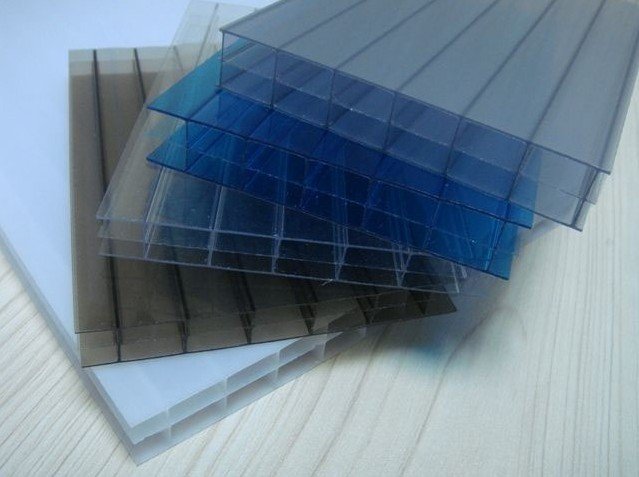
Multiwall polycarbonate sheets — also called PC hollow sheets — remain the most widely specified glazing material for daylighting in 2026. As a manufacturer, Jietai produces multiwall sheets in thicknesses from 4 mm to 30 mm, a standard width of 2100 mm, and structures ranging from twin-wall to honeycomb and X-braced. Clear sheets transmit up to 82% of light, and U-values run from 1.5 to 3.9 W/m²·K, so one product family covers everything from a lightweight greenhouse cover to a thermally insulated commercial skylight.
Complete 2026 Specification Range
Our factory produces multiwall polycarbonate to the following industry-standard ranges. Custom sizes and colours are available on request.
| Parameter | Available Range |
|---|---|
| Thickness | 4, 6, 8, 10, 12, 14, 16, 20, 25, 30 mm |
| Structure | Twin-wall (2-wall), triple-wall (3-wall), 4-wall, 5-wall X-braced, honeycomb |
| Standard width | 2100 mm |
| Custom widths | 1220 / 1560 / 1820 mm |
| Standard length | 6 m |
| Custom length | 1 – 12 m |
| Colours | Clear, opal, lake blue, grass green, bronze, red, orange, custom RAL |
| UV protection | Co-extruded UV layer, single or double sided, 30–50 μm |
| Weight | 1.0 – 3.5 kg/m² (by thickness and structure) |
| Light transmission | 25% – 82% (by thickness and colour) |
| U-value | 1.5 – 3.9 W/m²·K |
| Fire rating | B1 (GB 8624), UL94 V-0 to V-2, Euroclass B-s1,d0 |
| Temperature range | −40°C to +120°C |
| Impact strength | About 200× that of glass |
Structure Types and Thermal Performance
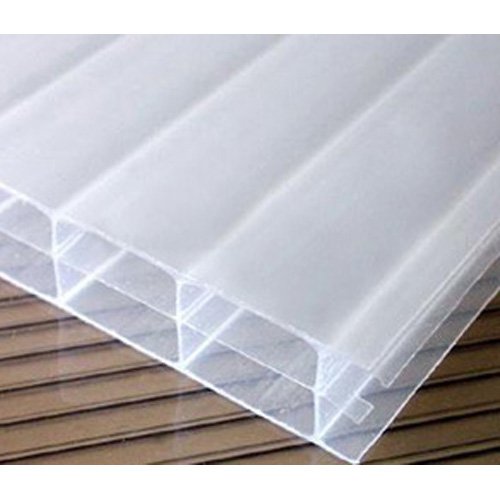
The internal structure is what separates one multiwall sheet from another. More walls and more air gaps mean better insulation and higher rigidity for the same thickness.
| Structure | Typical thickness | Min. bend radius | U-value |
|---|---|---|---|
| Twin-wall (2-wall) | 4 / 6 / 8 / 10 mm | 700 – 1750 mm | 2.9 – 3.8 W/m²·K |
| Triple-wall (3-wall) | 8 / 10 / 12 mm | 1400 – 2100 mm | 2.5 – 3.0 W/m²·K |
| 4-wall | 10 / 12 / 16 mm | 1750 – 2800 mm | 2.3 – 2.7 W/m²·K |
| Honeycomb | 8 / 10 / 12 mm | 1400 – 2100 mm | 2.5 – 3.0 W/m²·K |
| X-braced (5-wall) | 16 / 18 / 20 mm | 2800 – 3500 mm | 1.9 – 2.1 W/m²·K |
Light Transmission by Thickness and Colour
Light transmission is the key daylighting spec. Clear sheets pass the most light; tinted and opal sheets cut glare and control heat. The table below shows typical transmission values (%).
| Thickness | Clear | Opal | Bronze | Royal Blue | Lake Blue | Green |
|---|---|---|---|---|---|---|
| 4 mm | 80 | 57 | 58 | 45 | 55 | 45 |
| 6 mm | 79 | 56 | 50 | 36 | 50 | 42 |
| 8 mm | 78 | 52 | 44 | 30 | 47 | 40 |
| 10 mm | 78 | 44 | 40 | 28 | 42 | 35 |
| 12 mm | 75 | 42 | 38 | 25 | 40 | 34 |
Applications
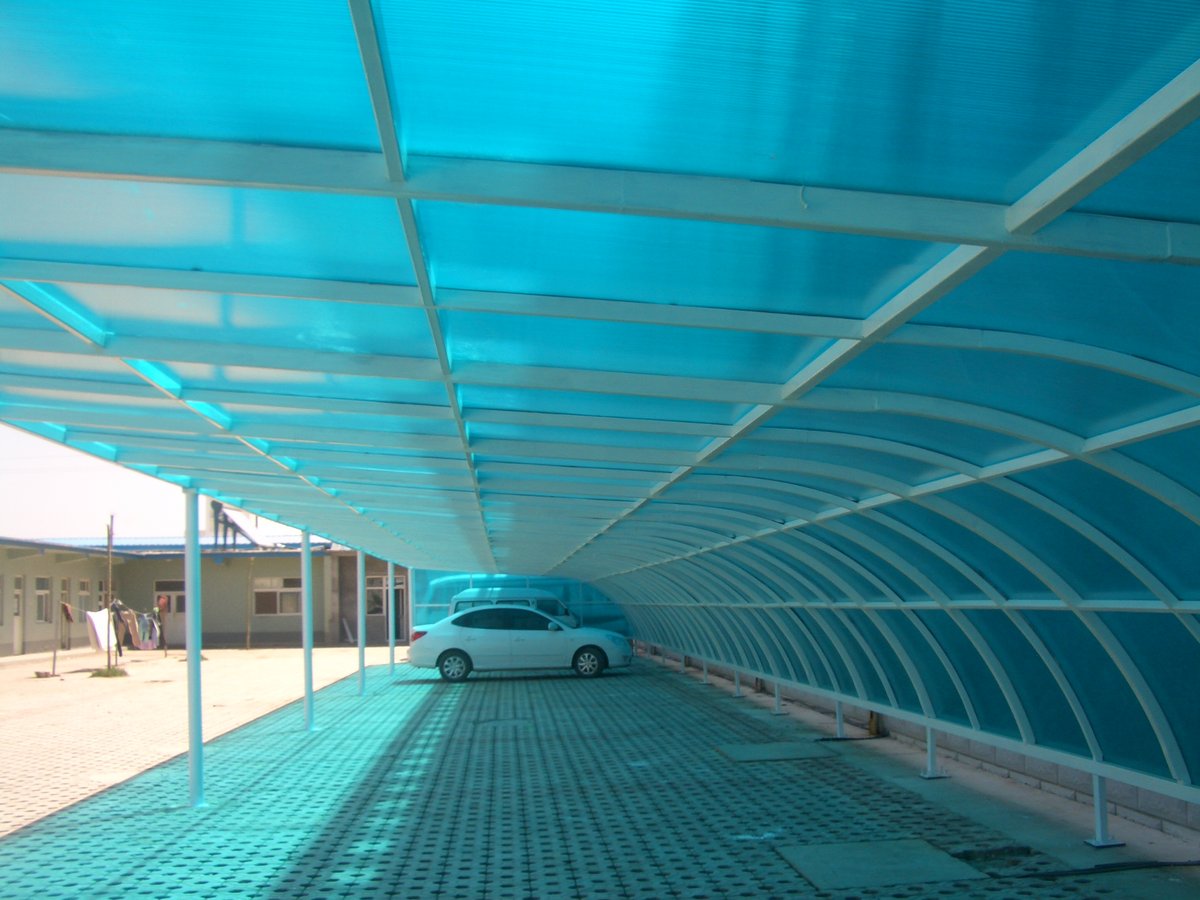
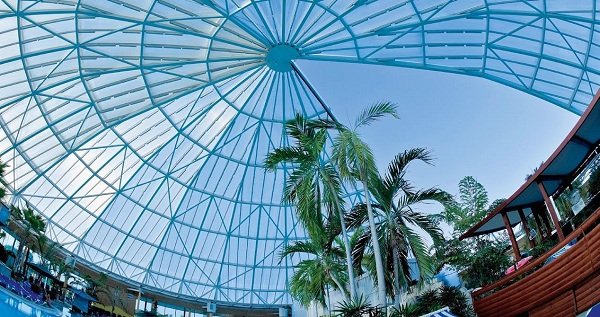
Multiwall polycarbonate is the default choice for any application that needs natural light plus impact safety and thermal control. Common uses in 2026 include greenhouses and agricultural tunnels, factory and warehouse daylighting, carports and canopies, skylights and atriums, sports-hall and swimming-pool roofs, and noise-barrier glazing.
Why Choose Jietai
Jietai is a polycarbonate sheet manufacturer, not a reseller, so specifications, UV co-extrusion and quality control are handled in-house. Every sheet is produced to GB 8624 Class B1 and UL94 fire standards, carries a co-extruded UV layer rated for 10–15 years of outdoor service, and is available in custom sizes and RAL colours. Contact our team for a quote with your thickness, width and quantity, and we will confirm the best specification for your project.
Frequently Asked Questions
What is the standard width of multiwall polycarbonate sheets?
The standard production width is 2100 mm, which is the industry norm for multiwall polycarbonate. Custom widths of 1220 mm, 1560 mm and 1820 mm are also available, so sheets can be cut to match almost any framing grid.
What thicknesses are available for multiwall PC sheets?
Multiwall sheets run from 4 mm up to 30 mm. Thin 4-6 mm twin-wall sheets suit lightweight covers and small canopies, 8-12 mm covers greenhouses and skylights, and 16-30 mm honeycomb or X-braced sheets are used where thermal insulation is the priority.
What is the difference between twin-wall and triple-wall polycarbonate?
Twin-wall has two outer walls with one row of air channels between them; triple-wall adds a third wall and a second air gap. The extra air layer lowers the U-value and raises rigidity, which is why triple-wall is preferred for insulated roofs and colder climates.
How much light does multiwall polycarbonate transmit?
Clear multiwall sheets transmit up to about 82% of light. Transmission drops as thickness increases and depends on colour: opal diffuses roughly 50-57%, bronze around 40-58%, and blue or green shades 25-45%. Opal is the usual choice when glare-free diffused daylight is needed.
What U-value can multiwall polycarbonate achieve?
U-values range from about 3.9 W/m²·K for thin twin-wall sheets down to about 1.5 W/m²·K for thicker honeycomb and X-braced structures. For a cold-climate insulated roof, a 16-30 mm honeycomb or X-braced sheet is the recommended option.