
Polycarbonate sheets leave the factory with a flawless surface. Whether it arrives on site in the same condition depends far less on the material than on four stages nobody photographs for the brochure: how it was packed, how it was stacked, how it was stored, and how long it sat in the sun with the film still on.
Most of the damage we get asked about is not transit damage in the insurance sense. It is film that has baked onto the face, sheets bowed from being stored upright against a wall, corners crushed by a strap, or water inside the flutes of a multiwall sheet that went into a container slightly damp. None of these show up in a photo taken at loading, and all of them are decided before the sheet ever moves.
This guide covers how polycarbonate sheets should be packed, stacked, stored and shipped — and the specific mistakes that turn a good sheet into a rejected delivery.
What the Protective Film Actually Does
Every sheet ships with a polyethylene film on one or both faces. It has two jobs, and only one of them is obvious.
- It protects the polished face from abrasion during handling, transport and machining. The film stays on while the sheet is cut and drilled — that is the point of it.
- It identifies the UV face. The printed film marks the side that must face the weather. On a sheet where both faces look identical, the film is the only reliable indicator of which way up it goes.
Film is supplied either as a static-cling film with no adhesive, or as an adhesive film. Static film is easier to remove and leaves no residue; adhesive film holds better on large sheets and during machining but must not be left on through a forming cycle. For any process involving heat — thermoforming, hot line bending — the film has to be removed first or replaced with a grade rated for that temperature.
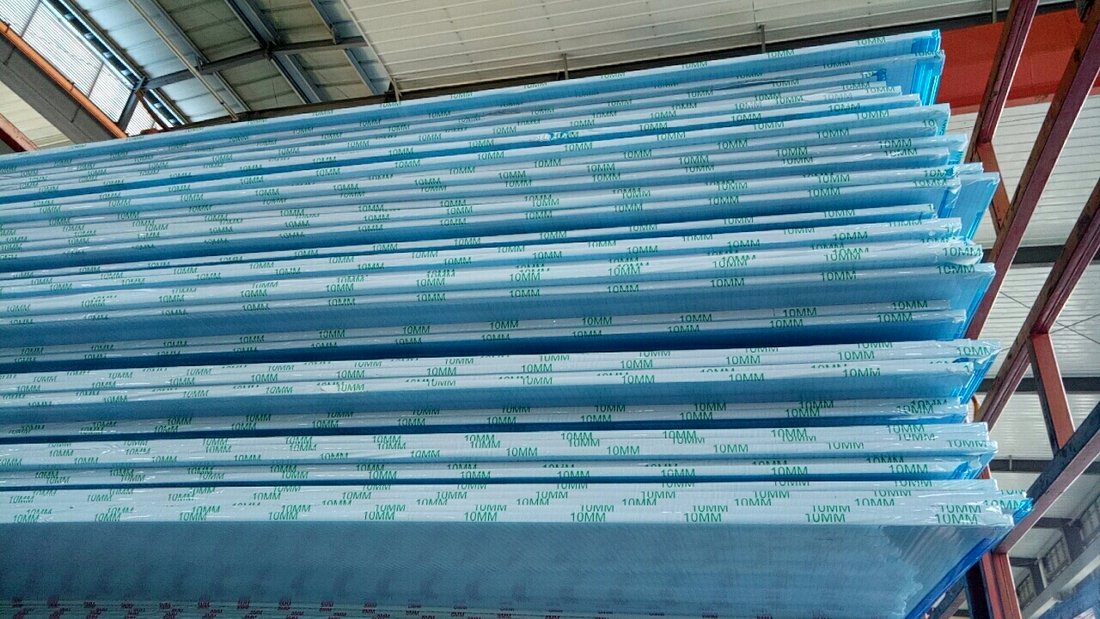
The Film Rule That Gets Broken Most Often
Remove the film as soon as the sheet is fixed in its final position. Not the next week, not when the scaffolding comes down, and not after the client’s inspection.
Polyethylene film degrades under ultraviolet light, moisture and repeated temperature cycling. It embrittles, then it bonds. Once it has bonded to the sheet, removal takes the surface with it or leaves a residue that no amount of cleaning will shift. Two situations make this dramatically worse:
- Outdoor storage in sunlight. Heat builds under the film, softens it, and fuses it to the face. A stack stored outdoors for a summer with the film on is a stack of rejects.
- A sealed container crossing the tropics. The film gets weeks of heat and high humidity at once. Sheets that arrive after a long sea voyage are the ones where the film comes off in fragments.
The practical instruction to pass on to the installer is short: leave it on while you handle and machine it, take it off the same day it is fixed.
How Polycarbonate Sheets Should Be Stacked
Polycarbonate is stiff but it creeps. A stack that is supported unevenly, or overhanging, will take a permanent set within weeks — and a bowed sheet cannot be flattened back into a glazing rebate.
| Rule | Reason |
|---|---|
| Longest sheet at the bottom | No unsupported overhang carrying load |
| Flat, continuous support | Prevents permanent curvature |
| Stack no higher than ~900 mm | Limits load on the bottom sheet |
| On a raised, soft surface | Cardboard or timber; no direct ground contact |
| Never walked on, never driven into | Impact damage and scratches at the centre of a stack |
| Nothing heavy or dark on top | Point loads, and heat build-up from dark objects |
Long-term storage changes one thing: where a stack will sit for weeks, inclined storage on a proper support is preferable to leaving it flat, because it sheds water and does not trap heat the same way. Upright on edge against a wall is the worst of both — the sheet bows under its own weight and the bottom edge takes the whole load.

Storage Conditions That Quietly Damage Sheets
| What people do | What happens |
|---|---|
| Store outdoors under the factory film | Film bakes on, becomes unremovable |
| Cover with a dark tarpaulin | Heat collects under it; film softens, sheet softens |
| Cover with flexible PVC sheet | Plasticiser migration causes stress crazing |
| Lay metal profiles or pipes on the stack | Conducts heat, point loads, scratched faces |
| Leave a wrapped pallet out in the rain | Water enters the wrapping; in multiwall, it enters the flutes |
| Store upright, leaning on one edge | Permanent bowing at the bottom edge |
The multiwall case deserves its own warning. Water that gets inside a flute cannot drain and cannot be cleaned out. It supports mould and algae growth, which permanently reduces light transmission and stains the sheet from the inside. A pallet that sat in the rain for a fortnight before loading is exactly how that starts — the wrapping keeps the rain out during the journey, but it also keeps the moisture in.
Where a stack must sit outside, cover it with an opaque white polyethylene sheet, cardboard or another insulating layer, and cover it completely. White, because it reflects rather than collects; opaque, because the film underneath must not see sun.

Container Loading and Length Limits
| Container | Maximum sheet length |
|---|---|
| 20 ft | About 5.8 m |
| 40 ft | About 11.8 m |
Those figures are hard limits, not guidelines — a sheet 20 cm over the usable internal length is a sheet that cannot be shipped in that container at all. Long sheets are also where loading damage concentrates, because the overhang at each end is what hits the door frame.
Practical points that prevent most container damage:
- Secure against movement in both directions. A stack that can slide fore-and-aft will slide, and a 5 m sheet that shifts 200 mm knocks its own corners off.
- Protect and seal the sheet ends. Multiwall flutes get taped at the ends so dust and insects cannot enter during the voyage.
- Do not load sheets flat under other cargo. Weight on the face of a stack is how you get a bowed delivery.
- Unload with a roller conveyor where possible, slanted and height-adjustable. Dragging a long sheet out of a container by hand is where the scratches happen.
- Consider the voyage, not just the day. A container crossing the equator in direct sun heats far above ambient. Anything heat-sensitive in the packing — adhesive film, some interleaving materials — has to survive that.
What Actually Arrives Damaged, and Why
| Symptom | Usual cause | Decided at |
|---|---|---|
| Film will not peel | Heat and UV with film on | Storage, or the voyage |
| Crushed or chipped corners | Unprotected ends, movement in transit | Packing / loading |
| Scratched face | Film removed too early, or grit between sheets | Handling |
| Sheet visibly bowed | Uneven support, or weight on the stack | Storage |
| Water marks inside flutes | Rain on a wrapped pallet | Storage before loading |
| Milky or crazed patches | Solvent or plasticiser contact | Storage or cleaning |
| Yellowed before installation | Long exposure with film on, or wrong face up | Storage / installation |
Read the third column. Almost none of these are decided on the road — they are decided in the yard, before the truck arrives. That is also why a claim after delivery usually fails: the evidence of the cause has already been removed.
Receiving Inspection Checklist
- Count the sheets and check the thickness and dimensions against the packing list before signing anything.
- Check the corners and the two long edges — corner damage is the most common transit claim.
- Look along the stack from one end: any sheet that is not straight is a support problem, and it will not flatten.
- Check for water marks or condensation inside the wrapping, especially on multiwall pallets.
- Peel a small corner of film on one sheet. If it comes away cleanly, the stack is fine; if it tears and sticks, stop and photograph it immediately.
- Photograph the packing as delivered, before unpacking. A claim without photos of the packing as received is very hard to support.
Where We Are Honest About the Limits
- Packing adds cost, and buyers negotiate it away. Thin film, no end protection and no interleaving is cheaper and it works — until a corner arrives broken. We quote a packing standard, and we would rather explain it than quietly cut it.
- Long sheets are inherently more exposed. Above about 4 m, handling and loading dominate the damage risk, whatever the packing. If your project will accept shorter lengths with a joint, that is often the more reliable delivery.
- We cannot control what happens after the container is opened. A pallet stored in the sun on site will still bake its film, however well it was packed. This is why the film instruction matters more than any packaging upgrade.
- Thin solid sheet creases where thick sheet does not. Very thin gauges need more support in the stack and more care on site; that is a property of the material, not a packing failure.
What to Confirm Before You Order
- Maximum sheet length, and whether the receiving site can handle it.
- Whether the sheets will be stored outdoors after delivery, and for how long.
- Whether the film needs to be a grade that can stay on during machining or forming.
- Whether the sheets are multiwall, in which case end sealing is not optional.
- Any container type constraint at your end, and who unloads.
Send those through our contact form and we will confirm the packing standard, the film type and the container plan before the order is fixed. If you are comparing suppliers, ask each of them what film they use and how the flutes are sealed — those two answers tell you more about how the sheets will arrive than any photo of a warehouse.
Frequently Asked Questions
How long can the protective film stay on a polycarbonate sheet?
Through handling, machining and installation — and no longer. It should come off the same day the sheet is fixed. Film left on through weeks of sun embrittles and bonds to the surface, and in a hot container it can do the same in a single voyage.
Can polycarbonate sheets be stored upright?
Not leaning on one edge. A sheet stored upright bows under its own weight and takes a permanent set, usually along the bottom edge. Store flat on a continuous support, or inclined on a proper rack if the stack has to sit for weeks.
What is the maximum sheet length for a container?
Roughly 5.8 m in a 20 ft container and 11.8 m in a 40 ft container. Those are practical internal limits — anything longer cannot be loaded in that box at all, so sheet length has to be fixed before the order, not before the loading day.
Why are there water marks inside my multiwall sheets?
Moisture entered the flutes and could not drain. Most often the pallet was stored in the rain before loading, with the wrapping keeping the water in rather than out. It supports mould growth and cannot be cleaned out, so the sheet has to be replaced.
Is a dark tarpaulin acceptable for covering sheets outdoors?
No. Dark material absorbs heat and delivers it to the stack, softening the film and the sheet underneath. Use an opaque white polyethylene sheet, cardboard or similar, and cover the stack completely. Flexible PVC covers should be avoided entirely — plasticiser migration causes stress crazing.
How should sheets be stacked for storage?
Flat, on a continuous and raised surface, longest sheet at the bottom with no unsupported overhang, maximum stack height around 900 mm, with nothing heavy or dark placed on top. Never allow the stack to be walked on or struck by vehicles.
Ask what the packing actually includes
Tell us your sheet lengths, destination and how long the sheets will sit before installation, and request a quote with the packing standard written into it — film grade, end protection and container plan included.
- Send lengths, quantity and storage conditions on site
- We confirm film type, packing and loading plan
- You receive a packing specification with the quotation