
Aluminium composite panel is a sandwich: two thin aluminium skins bonded to a core that does the work of stiffness. That construction is why a 4 mm panel weighs about 5.5 kg/m² instead of the 11 kg/m² of solid aluminium of the same stiffness, and why it can be folded into a cassette on site rather than fabricated in a press shop. The core is the specification that matters, because it decides the fire class and therefore which buildings the panel can be used on at all.
Request a Quote Ask for Free Samples
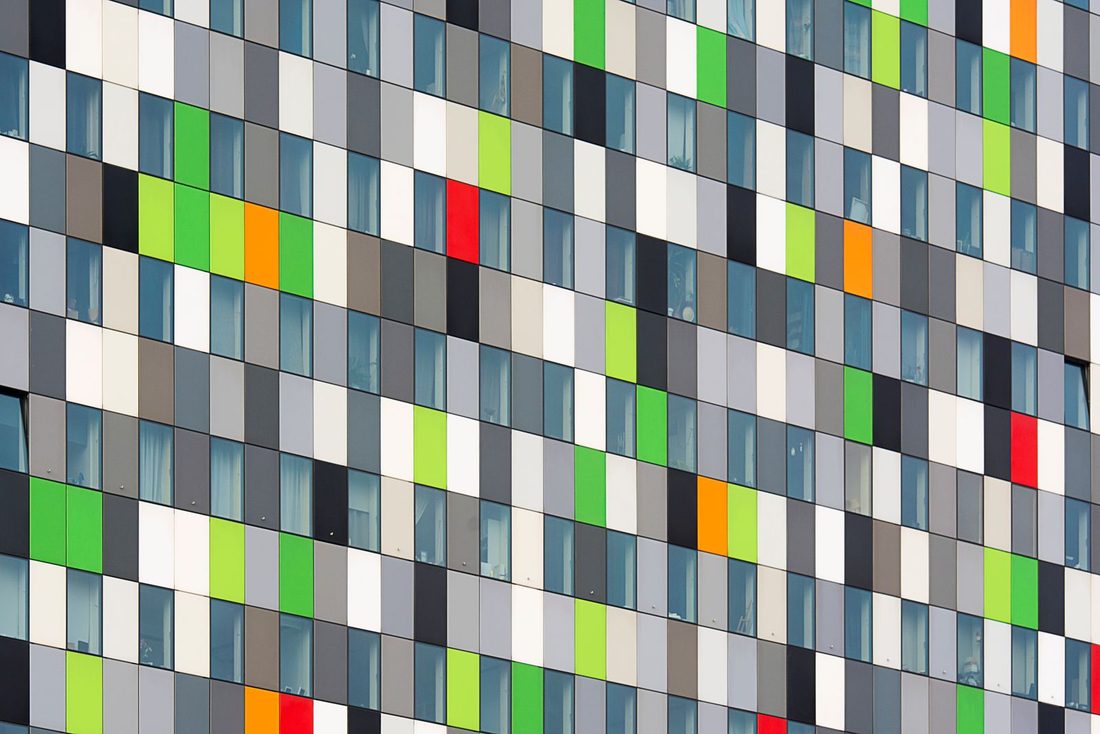
This page covers the core grades and which buildings each one is permitted on, the skin thickness question, the comparison with solid aluminium and honeycomb, and the fabrication rules. Core construction and compliance are covered in detail in the core grades and facade compliance guide, the joint design in facade grid and joint design, and everything published on this range is indexed in the aluminium composite panel articles.
Aluminium Composite Panel Specifications
Range at a glance
| Panel thickness | 3 / 4 / 6 mm standard |
|---|---|
| Standard size | 1220 × 2440 mm |
| Large format | 1500 × 3050 mm, 1500 × 3200 mm, 2000 × 3000 mm |
| Skin thickness | 0.21 / 0.30 / 0.40 / 0.50 mm per face |
| Core | PE, FR (fire retardant) and A2 mineral |
| Coating | PVDF for exterior, polyester for interior |
| Weight | approx. 4.5 kg/m² at 3 mm, 5.5 kg/m² at 4 mm |
| Service temperature | −50 to +80 °C |
| Reaction to fire | B-s1,d0 for FR core; A2-s1,d0 for mineral core |
| Bending | V-groove and fold, minimum 25 mm from the edge |
| Minimum order (MOQ) | 1 × 20GP container — mixed sizes and colours accepted |
The Core Decides the Building
Three cores are sold in the same panel format, at very different prices, and the difference is not cosmetic:
| Core | Fire performance | Where it is permitted |
|---|---|---|
| PE (polyethylene) | Combustible; B2 or E class | Interior use, low-rise, signage and shopfronts where the code allows |
| FR (fire retardant) | B-s1,d0 to EN 13501-1 | Most mid-rise facades and general cladding |
| A2 mineral | A2-s1,d0; essentially non-combustible | High-rise, public buildings, escape routes, anywhere the code demands limited combustibility |
This is the first question to settle, not the panel colour. A PE-core panel on a high-rise facade is not a cheaper option; it is a non-compliant one, and the difference between the grades is small compared with re-cladding a building. Send us the building height and the applicable code and we will confirm the core before quoting.
Skin Thickness: What 0.21 mm and 0.50 mm Actually Mean
Two panels can both be described as “4 mm ACP” and differ by more than double in aluminium content. Skin thickness decides:
- Flatness. Thin skins telegraph substrate irregularities and oil-can between fixings on large panels.
- Dent resistance. A 0.21 mm skin dents under a hand push; 0.50 mm resists normal site contact.
- Fold strength. The folded return is only as strong as the skin, and thin skins tear at the fold.
- Coating life. Coating performance is measured on the skin, so a thin skin with 20-year PVDF is a mismatch.
0.30 mm is the common exterior specification; 0.40 to 0.50 mm where the facade is large-format, high-profile or subject to impact. 0.21 mm belongs on interior work and short-life signage. Ask for the skin thickness in writing — it is the number most often left out of a quotation.

ACP vs Solid Aluminium vs Honeycomb
| Property | Aluminium composite | Solid aluminium | Aluminium honeycomb |
|---|---|---|---|
| Weight at equal stiffness | Light, approx. 5.5 kg/m² at 4 mm | Heavy, approx. 11 kg/m² | Lightest |
| Flatness on large panels | Good | Poor on thin sheet | Best |
| Folding on site | Yes — V-groove and fold | No; needs a press brake | No |
| Fire performance | Depends entirely on the core | Non-combustible | Depends on skins and adhesive |
| Cost | Lower | Higher | Highest |
| Typical use | Facades, soffits, signage, interiors | High-specification facades | Large-span and high-flatness facades |
The trade-off is simple: ACP buys stiffness with a light core and pays for it in fire performance, which is why the core grade — not the panel — is the compliance question. Solid aluminium removes that question and doubles the weight and cost. Honeycomb is for spans and flatness demands that ACP cannot meet.
Fabrication: V-Groove, Fold and Fix
- V-groove depth. Cut through the skin and into the core, leaving about 0.3 to 0.5 mm of core intact — enough to fold without tearing, not enough to hold a visible radius.
- Edge distance. Keep grooves at least 25 mm from the panel edge, or the corner tears when folded.
- Fold once. A fold cannot be opened and re-folded; the skin work-hardens and cracks. Set out the cassette before cutting.
- Cutting. Circular saw or router with a carbide blade; the protective film stays on during cutting and comes off as soon as installation is finished — 45 days in sun is the practical limit before adhesive transfer.
- Fixing. Rivets or brackets into the fold, with slotted holes for thermal movement; the panel expands about 0.024 mm per metre per degree.
- Sealing. The joint is drained and vented, not filled solid. Sealant width should be about twice its depth and a backing rod about 25 % larger than the gap.
Supply, Coating and Container
- Coating. PVDF for exterior colour and gloss retention over 15 to 20 years; polyester for interior work. Specify which one the quote includes.
- Formats. Standard 1220 × 2440 mm, plus 1500 mm wide and 3050/3200 mm long for facade work; cut-to-size and routed cassettes on request.
- Packing. Filmed, interleaved and crated on edge. Panels are flat-packed and must not be stored flat on a floor — they take a set.
- Mixing. ACP ships efficiently because it is light and flat; long panels are limited by container length, not weight.
Where We Are Honest About the Limits
- A PE core is not a facade panel. Where the code requires a limited-combustibility or non-combustible core, PE is not a saving, it is a failure at inspection. We will refuse to quote it for that use.
- ACP is not a structural material. It is a cladding panel. Wind load is carried by the framing behind it, and the panel transfers load through its fixings, not through its skin.
- Thin skins limit everything. A 0.21 mm panel is an interior and signage product. Selling it as an exterior facade panel is where most quality complaints originate.
- Cut edges are exposed core. Every cut or groove exposes the core, and that edge has to be closed or protected. It is the part of the system that gets forgotten on site.
- Fire classification is assembly-dependent. Core, adhesive, coating and the fixing system all contribute to what an inspector assesses, and a panel classification does not automatically transfer to a finished facade.
- Colour varies between batches. Metallic and pearlescent PVDF finishes in particular cannot be matched exactly across production runs, so a facade should be ordered as one batch.
More on Aluminium Composite Panels
Core construction, skin thickness and facade compliance are set out in the core grades guide; panel module, joint width and sealing in facade grid and joint design. Send the building height, the applicable fire requirement and the panel area and we will confirm the core and skin before quoting.
Aluminium Composite Panel: Common Questions
A2 mineral core, essentially non-combustible, for high-rise and public buildings where the code requires limited combustibility. FR core at B-s1,d0 covers most mid-rise facades. PE core is combustible and is not a compliant facade option regardless of price.
0.30 mm is the common exterior specification. Use 0.40 to 0.50 mm for large-format, high-profile or impact-exposed facades, and treat 0.21 mm as an interior and signage product rather than a facade panel.
About 4.5 kg/m2 at 3 mm and 5.5 kg/m2 at 4 mm, roughly half the weight of solid aluminium of equivalent stiffness. That weight advantage is the main reason the material is used on large facades.
Yes. It is V-grooved through the skin into the core, leaving about 0.3 to 0.5 mm of core, then folded into a cassette. Grooves must be at least 25 mm from the edge, and a fold cannot be opened and re-folded because the skin work-hardens.
PVDF holds colour and gloss outdoors for 15 to 20 years and is the exterior specification. Polyester is for interior work and short-life signage. A thin skin with a long-life coating is a mismatch worth avoiding.
About 0.024 mm per metre per degree, which is less than polycarbonate but still enough that fixings need slotted holes. The joint should be drained and vented rather than filled solid with sealant.
Send your building height, fire requirement and panel area
Send us these four details and we will come back with a landed cost:
- Sheet type and thickness
- Size and quantity
- Application (roof / skylight / partition...)
- Destination country or port