
Acoustic panel is sold on its looks and bought for its numbers, and the two are decided by different things. The slats and the felt face are what the client chooses; the cavity behind them is what decides whether the wall actually absorbs sound. The same panel measures NRC 0.54 fixed flat to a wall and NRC 0.95 over a 50 mm filled cavity, so the mounting is not a detail of the acoustic specification — it is most of it.
Request a Quote Ask for Free Samples
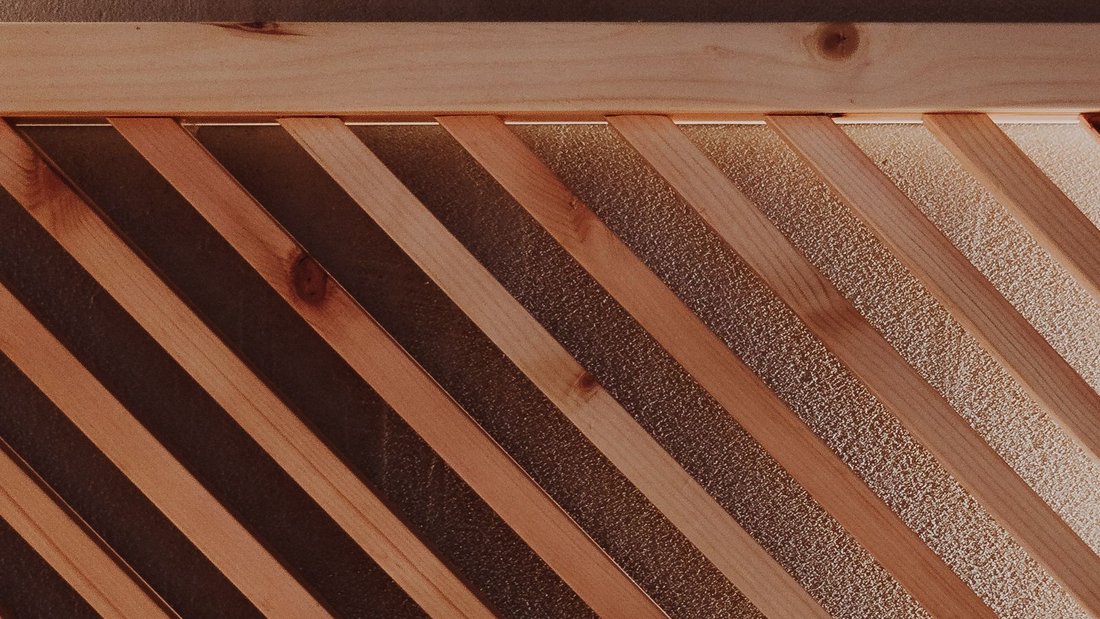
This page covers the build of the panel, the NRC figures by mounting method, how much cavity to allow, where acoustic panels and acoustic ceilings divide, and what to specify for a quotation. The open-area calculation is set out in slat ratio, felt backing and cavity, felt and NRC in the acoustic panel specification guide, and everything published on this range is indexed in the acoustic panel articles.
Acoustic Panel Specifications
Range at a glance
| Build | Wood or MDF slats on a PET felt backing |
|---|---|
| Slat width | 20 – 35 mm |
| Slat thickness | approx. 12 mm |
| Gap between slats | 8 – 18 mm (decides open area) |
| Felt thickness | 9 – 12 mm |
| Felt density | 160 – 200 kg/m³ PET, recycled content available |
| Panel size | 600 × 600, 600 × 1200, 600 × 2400 mm |
| NRC | 0.54 flat to 0.95 over a filled 50 mm cavity |
| Fire | B-s1,d0 on specified build-ups |
| Installation | Direct bond, or screwed to battens with cavity |
| Cleaning | Vacuum with a brush head; damp cloth on the slats only |
| Minimum order (MOQ) | 1 × 20GP container — mixed profiles and colours accepted |
The NRC Figure Depends on How It Is Mounted
This is the single most useful table on the page, and the reason a supplier’s quoted NRC is meaningless without the mounting:
| Mounting | Absorption at 125 Hz | NRC |
|---|---|---|
| Fixed flat to the wall | 0.04 | 0.54 |
| 25 mm cavity behind | 0.04 | 0.70 |
| 50 mm cavity behind | 0.17 | 0.80 |
| 50 mm cavity, mineral wool filled | 0.44 | 0.95 |
Read the 125 Hz column first. Flat to the wall, the assembly absorbs almost nothing at the bottom of the range, which is why a slat wall glued onto plasterboard fixes the flutter echo and leaves the low-frequency boom untouched. If the complaint is that the room still sounds hollow after treatment, this table is the answer: it was installed flat.
How Much Cavity to Allow
- No cavity — visual treatment only. Accept that low frequency is unaffected and specify it that way rather than promising absorption.
- 25 mm battens — a real improvement in the mid band with minimal loss of room size; the usual compromise in offices and meeting rooms.
- 50 mm battens — where low-frequency control starts to matter, such as media rooms and open-plan areas with a bass problem.
- 50 mm plus mineral wool — the full specification, NRC 0.95, and the only one of the four that lifts 125 Hz meaningfully.
- Ceilings — the plenum above a suspended grid usually provides more cavity than a wall, which is why acoustic ceilings often outperform acoustic walls in the same room.

Acoustic Panels and Acoustic Ceilings Divide the Job
| Room problem | What fixes it |
|---|---|
| Flutter echo between parallel hard walls | Wall panels, even flat-mounted |
| Speech privacy between desks | Ceiling absorption plus screens; panels alone are not enough |
| Reverberation in a large hall | Ceiling absorption is usually the largest available area |
| Bass build-up in a media room | Cavity and mineral wool, on walls and ceiling |
| Noise transfer between rooms | Neither — that is a partition and flanking problem, not absorption |
The last row is worth stating plainly: acoustic panels absorb sound within a room. They do not stop sound travelling to the next room, which is a mass and isolation problem. Where a client asks for panels to reduce noise through a wall, the correct answer is a partition upgrade, and the panels are a separate purchase.
Open Area and Slat Layout
Open area is the gap divided by the pitch — gap plus slat. A 25 mm slat with a 12 mm gap gives about 32%; with 25 mm gaps it gives 50%. Wider gaps expose more felt and absorb more; narrower gaps look tighter and absorb less. The design decision is usually made on appearance and then has to be checked against the acoustic requirement, not the other way round.
One trap: two layouts with the same open area are not acoustically identical. A 21 mm slat with a 21 mm gap and a 42 mm slat with a 42 mm gap both give 50%, and published comparisons show the wider pattern dipping around 4 kHz. Matching the percentage is not matching the performance.
Supply, Finish and Container
- Sizes. 600 × 600, 600 × 1200 and 600 × 2400 mm; custom lengths within container limits. Larger panels mean fewer joints on a continuous wall.
- Slat and felt. Slat width, gap, felt thickness and felt density all specified at order — none of them can be changed on site.
- Battens and trims. Battens, end caps, internal and external corners in the same finish. The cavity depth should be on the same order as the panels.
- Packing. Panels are light and bulky; a container cubes out before it weighs out, so plan by volume.
- Spares. Hold 2 to 5 % in the same batch — a panel from a later production run shows a change in rhythm on a continuous wall.
Where We Are Honest About the Limits
- We sell an assembly, and the number depends on the mounting. We can state what a given build-up measures in a defined mounting; we cannot promise that figure for a wall we have not seen detailed.
- Flat-mounted panels do not fix bass. At 125 Hz a flat-mounted panel absorbs almost nothing. If low frequency is the complaint, the cavity and insulation are the answer, not a prettier slat pattern.
- They do not soundproof. Absorption and isolation are different problems. Panels will not reduce noise passing to the next room, and selling them for that is misleading.
- Felt is not a fire barrier. Fire classification depends on the whole build-up including adhesive and substrate, and a rating for one construction does not transfer to another.
- Slat tolerance is visible. Slat width is held to roughly 0.3 mm. A wall built from two production batches can show a slight change in rhythm, which is why we recommend one batch per elevation.
- Cut edges need care. Cutting the panel on site exposes the felt and the core; end caps should be part of the order rather than improvised.
More on Acoustic Panels
The open-area formula and the cavity comparison are covered in slat ratio, felt backing and cavity; felt specification and NRC in the acoustic panel specification guide. For ceilings, see acoustic ceiling design, NRC and CAC. Send the room type, the wall or ceiling area and whether a cavity can be built, and we will state the NRC for that mounting before quoting.
Acoustic Panel: Common Questions
It depends on the mounting more than the panel. A felt-backed slat panel measures about NRC 0.54 fixed flat to a wall, 0.70 over a 25 mm cavity, 0.80 over 50 mm, and 0.95 over a 50 mm cavity filled with mineral wool. Always ask which mounting a quoted figure refers to.
No. Panels absorb sound within the room and reduce reverberation. Stopping noise passing through a wall is a mass and isolation problem, which needs a partition upgrade rather than absorption treatment.
25 mm gives a real mid-band improvement with minimal loss of room size. 50 mm is where low-frequency control begins, and 50 mm filled with mineral wool is the full specification at NRC 0.95.
15 to 18 mm for acoustic priority, 8 to 12 mm where the tighter visual line matters more, and 12 to 15 mm as the usual compromise. Open area is gap divided by gap plus slat width.
Only if they have a cavity, and the mineral wool matters more than the slats. A flat-mounted panel absorbs almost nothing at 125 Hz, which is exactly where a bass problem sits.
Yes, and the plenum above a suspended ceiling usually gives more cavity than a wall, which is why ceilings often outperform walls acoustically in the same room. Fire performance and fixing must be confirmed for overhead installation.
Send your room type, area and whether a cavity can be built
Send us these four details and we will come back with a landed cost:
- Sheet type and thickness
- Size and quantity
- Application (roof / skylight / partition...)
- Destination country or port