Bottom line: polycarbonate is the safest and most practical glazing material for school and kindergarten canopies. It weighs a fraction of glass, takes knocks and stray balls without shattering into sharp shards, and carries a co-extruded UV layer that stops it yellowing — exactly what an education facility needs over an entrance, a play area or a walkway where children pass underneath every day.
What a school canopy is
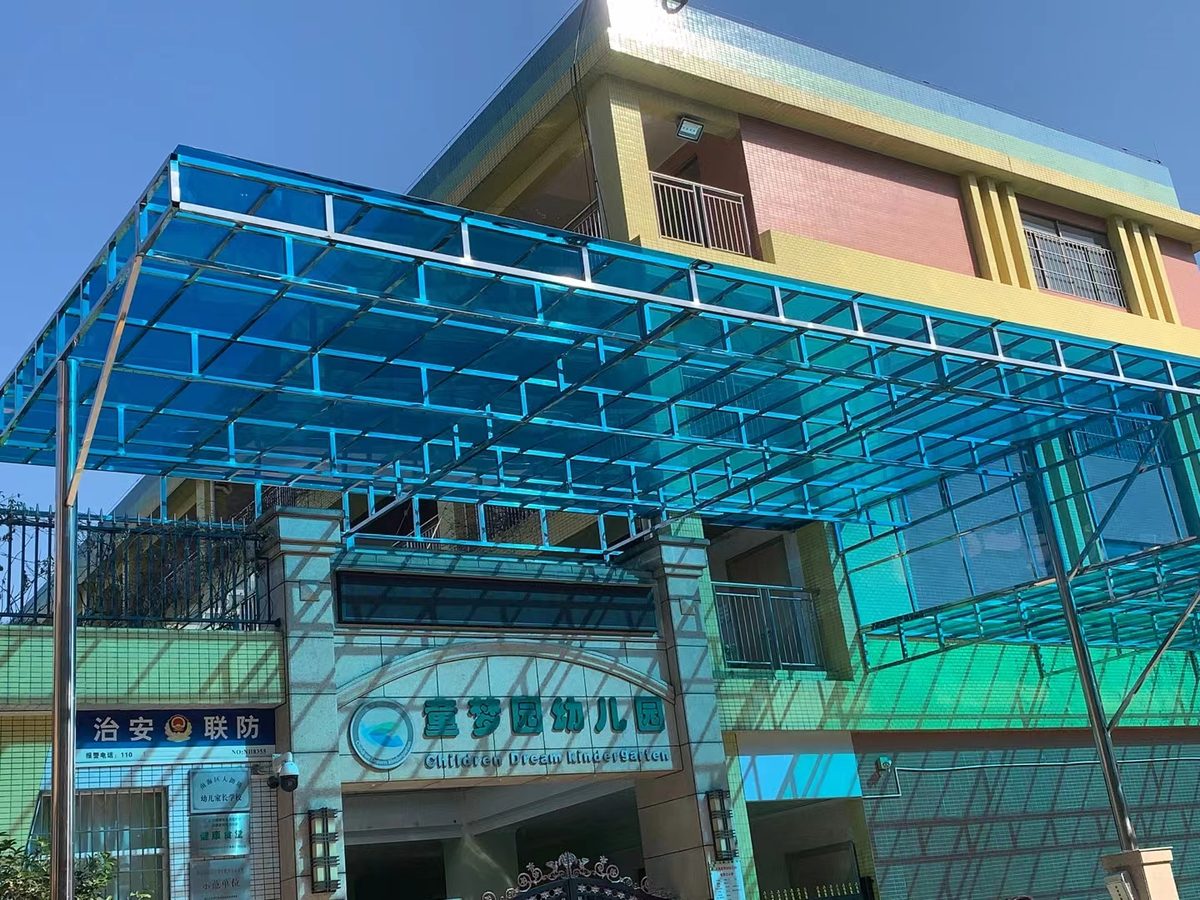
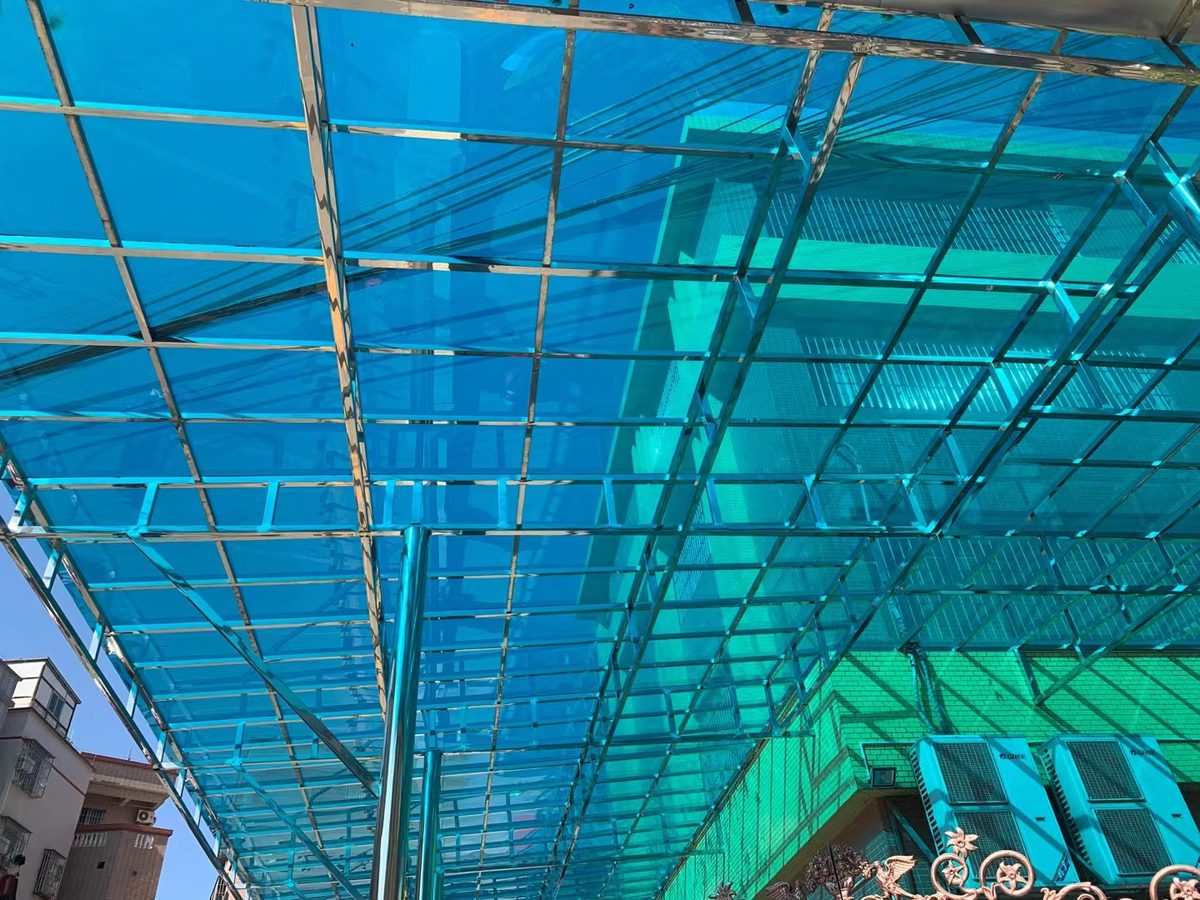
A school or kindergarten canopy is a lightweight glazed roof, normally carried on a steel or aluminium frame, that shelters an entrance, a play area or a connecting walkway. It keeps rain off, cuts glare and lets daylight through at the same time. Most education canopies use multiwall polycarbonate where some insulation helps, or solid polycarbonate where a clearer, glass-like view is wanted — often in blue, green or opal tints to control heat and brightness.
Why education facilities choose polycarbonate
Safety first. Polycarbonate is about 200 times the impact strength of glass and, unlike glass, it bends instead of breaking into sharp pieces. Over a kindergarten doorway or under a climbing frame, that matters.
Light weight. A 4–10 mm multiwall panel weighs only 1.0–3.5 kg/m², so the supporting frame, columns and footings can be lighter and cheaper than a glass canopy would demand.
UV stability. The co-extruded UV layer (30–50 μm) on the weather face blocks the wavelengths that cause yellowing and embrittlement, so the canopy stays clear for years without extra coating.
Fire performance. Sheet is available in UL94 V-0 to V-2 and B1 grades, which covers most building-code requirements for public and education buildings.
Daylight without glare. Multiwall sheet transmits 25–82% of light and diffuses it, while clear solid sheet transmits up to 89% — bright, even light with no harsh hot spots.
Where they are used
The same system scales from a single kindergarten doorway to a long covered walkway:
- Entrance shelters over school and kindergarten doorways, giving children and parents a dry, shaded drop-off point.
- Play area covers that keep sandpits, climbing frames and outdoor classrooms usable in sun and light rain.
- Walkway and corridor covers linking classrooms, canteens and halls without breaking the daylight.
- Skylights and atriums in assembly halls and gymnasiums.
Specifications at a glance
| Parameter | Multiwall polycarbonate | Solid polycarbonate |
| Thickness | 4–30 mm | 1.5–30 mm |
| Common canopy range | 4–10 mm | 3–6 mm |
| Standard width | 2100 mm | 1220 / 1560 / 1820 / 2100 mm |
| Structure | twin-wall, triple-wall, X-structure | solid |
| Light transmission | 25–82% | up to 89% (clear) |
| Weight | 1.0–3.5 kg/m² | 1.2–7.2 kg/m² |
| Impact strength | does not shatter | 200–250× glass |
| UV layer | co-extruded | co-extruded |
| Fire rating | B1 / UL94 V-0~V-2 | B1 / UL94 V-0~V-2 |
| Service temperature | −40 °C to +120 °C | −40 °C to +120 °C |
Design and installation notes
- Thermal expansion. Allow roughly 3 mm of movement per metre of panel length, and drill oversize holes with EPDM-washered fixings so the sheet can move.
- UV side orientation. Mount the UV-protected face to the weather side; it is marked on the film for correct orientation.
- Drainage fall. Give the canopy a minimum slope so rain runs off and no water pools on the glazing.
- Closed edges. Seal the open flutes of multiwall sheet with breather tape and end profiles to keep dust and condensation out.
Our solution
As a manufacturer, Jietai supplies both multiwall and solid polycarbonate sheet for education canopies, cut to size with the UV-protected face marked for correct orientation. Sheet is available in clear, blue, green and opal tints across the full thickness range, with flame-retardant grades on request.
Why source from a manufacturer
Jietai is a manufacturer serving contractors, fabricators and school-project suppliers directly. Sourcing direct means your sheet is produced to the thickness, tint and UV specification the project calls for, and cut to size before it ships — no off-the-shelf compromise on a canopy that children walk under every day.
Frequently asked questions
What thickness of polycarbonate is best for a school canopy?
4–10 mm multiwall is the usual choice for an insulated entrance or walkway cover; 3–6 mm solid sheet gives a clearer, glass-like view where appearance matters more than insulation. Larger spans and heavy snow loads push the range towards the upper end.
Is polycarbonate safe above children?
Yes. It is roughly 200 times the impact strength of glass and bends rather than breaking into sharp pieces, and flame-retardant (UL94 V-0~V-2 / B1) grades are available where building codes require them.
Does a polycarbonate canopy yellow or go brittle outdoors?
No. The co-extruded UV layer on the weather face blocks the wavelengths that cause yellowing, so with the UV side correctly oriented the canopy keeps its clarity for years.
What colours work best for a school or kindergarten canopy?
Blue, green and opal tints reduce heat and glare while still passing daylight; clear maximises light transmission. The tint is added during production, not painted on, so it does not fade or peel.
Can the panels be cut to fit an existing frame?
Yes. Sheets are cut to size from standard 2100 mm (multiwall) or 1220–2100 mm (solid) widths, and custom widths can be produced to suit the frame.