Bottom line: polycarbonate sheet is only as good as the system that holds it. The aluminum profiles, EPDM sealing gaskets and fasteners around the panel do the real work of a long-lasting installation — they carry the sheet, absorb thermal expansion, and keep water out without crushing or cracking the panel. This guide covers the complete accessory set: what each component does, the standard types, and how to choose them for multiwall, solid and corrugated polycarbonate.
What the accessory system includes
A polycarbonate panel should never be screwed rigidly to a frame. Polycarbonate expands and contracts with temperature — roughly 6.5 mm per metre over a 100 °C range — so it must be clamped, not hard-fixed, and every edge has to be sealed, drained and left room to move. The accessory system splits into four groups: aluminum profiles, sealing and waterproofing, fasteners, and finishing materials.
Complete accessory specification
| Accessory group | Standard components | Purpose |
|---|---|---|
| Aluminum profiles | H-type connectors, U-type edge trim, aluminum pressure strips, aluminum rails, I-beam purlins, U-type aluminum channels, lock covers, corner connectors | Frame, support and panel connection |
| Sealing & waterproofing | EPDM gaskets, butyl waterproof tape, breathable tape, silicone sealant, end caps | Waterproofing, sealing and condensation control |
| Fasteners | Self-tapping screws with EPDM washers, stainless steel sliding clips, thermal expansion spacers | Secure fixing with expansion allowance |
| Finishing materials | Aluminum flashing, drip edge, dust mesh, cleaning gel, PC primer | Edge protection, drainage and upkeep |
Aluminum profiles
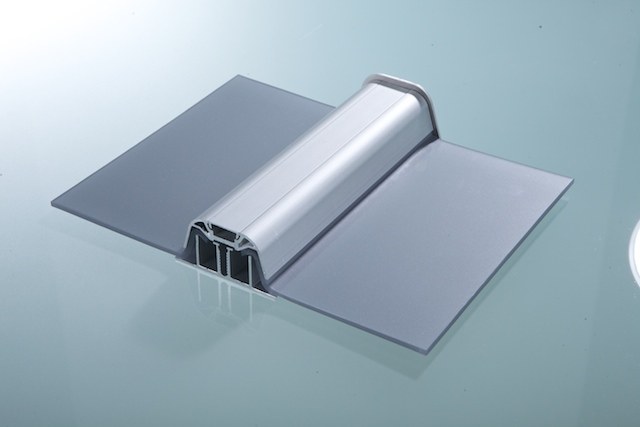
Aluminum profiles carry the panel and close its edges. The most common are H-type connectors that join two sheets edge-to-edge without exposing the cut ends, U-type edge trim and aluminum pressure strips that clamp a sheet onto a rail, and aluminum rails and I-beam purlins that form the load-bearing grid under a roof or skylight. Lock covers snap over the fasteners, and corner connectors finish the joints. Profiles are usually extruded 6063-T5 aluminum, anodised or powder-coated in silver, black or white, and cut to the sheet width.
Sealing and waterproofing
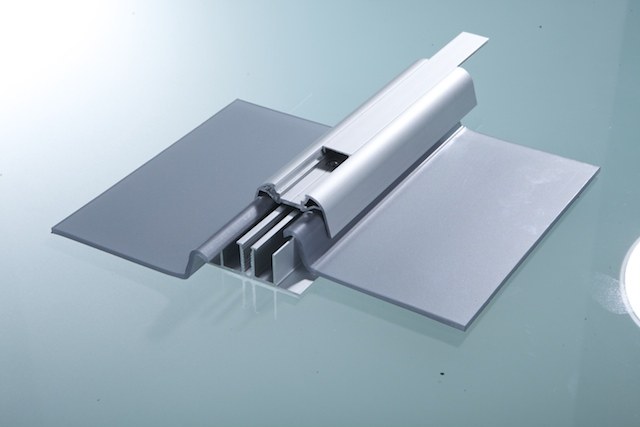
EPDM gaskets sit between the sheet and the metal profile, cushioning the panel and sealing the joint while still letting it slide with temperature changes. Butyl tape and silicone sealant close overlaps and ends; breathable tape lets condensation drain out of multiwall flutes while keeping dust and insects out, and end caps close the open flute ends. For roofs the rule is physical drainage first: slope the sheet at least 5° (1:20), overlap correctly, and rely on gaskets rather than sealant alone.
Fasteners
Fixings must hold the sheet without pinching it. Self-tapping screws with EPDM washers are the standard choice — the washer seals the hole and the screw is tightened only until the washer just touches the sheet. For panels that move a lot, such as long runs of multiwall or corrugated sheet, stainless steel sliding clips grip the sheet and let it expand freely instead of forcing it through drilled holes. Thermal expansion spacers reserve the correct gap between the sheet edge and the frame. As a rule, pre-drill holes slightly larger than the screw shank and allow about 6 mm of clearance per metre of sheet length.
How to choose the right accessories
Match the accessory to the sheet type and the job. Multiwall sheet needs H-connectors, end caps and breathable tape to manage the flutes. Solid sheet is cold-bent and uses gaskets with a pressure-strip system. Corrugated sheet matches its wave profile to the steel or glazed-tile roofing it sits on. Roofs and skylights take the full waterproofing set, while vertical facades and interior partitions can be lighter on drainage but still need profiles and gaskets.
Where the full system is used
The complete accessory system goes into every polycarbonate installation: greenhouse and factory roofs, carports and canopies, skylights and atriums, sound barriers, facades and interior partitions. Choosing profiles, gaskets and fasteners from one system keeps the components compatible and the installation clean.
Need profiles, gaskets or fasteners matched to your sheet type and span? Contact our team for a quote, samples and current lead times.
Frequently Asked Questions
Can polycarbonate sheet be screwed directly to a frame?
No. Polycarbonate expands and contracts with temperature, so rigid fixing will buckle or crack the sheet. Clamp it with aluminum profiles and EPDM gaskets, and fasten through oversized pre-drilled holes with EPDM-washered screws so the panel can move freely.
What size drill hole should I use for polycarbonate sheet?
Pre-drill holes slightly larger than the screw shank — usually 2–3 mm bigger — and leave about 6 mm of clearance per metre of sheet length. The screw is tightened only until the EPDM washer just touches the sheet; never overtighten.
What is the difference between an H-connector and a U-channel?
An H-connector (H-type profile) joins two sheets edge-to-edge in one continuous run, while a U-channel or U-type edge trim caps a free edge against a wall, beam or frame. Both hold the sheet with gaskets and leave room for thermal movement.
Do I need EPDM gaskets, or is silicone sealant enough?
Use both, but do not rely on sealant alone. EPDM gaskets seal the joint mechanically and last far longer, while silicone closes overlaps and small gaps. For roofs, physical drainage and gaskets come first; sealant is the secondary line of defence.
Which accessories do I need for corrugated polycarbonate roofing?
Corrugated sheet needs fasteners with EPDM washers, lapping screws at overlaps, and matching wave-profile closure strips or ridge flashing. Match the sheet profile (840, 900, 930 or 970) to the roofing it sits on and add EPDM gaskets at every overlap.