One of the most common issues installers face with polycarbonate sheets is buckling, warping, or joint failure — and in most cases, the root cause isn’t a defective product but improper gap allowance during installation. Polycarbonate expands and contracts significantly with temperature changes, and without adequate space for this movement, even the highest-quality sheets can deform.
How Much Does Polycarbonate Expand?
Polycarbonate has a linear thermal expansion coefficient of approximately 0.065 mm per meter per degree Celsius (mm/m·°C). This means a 6-meter-long polycarbonate sheet will expand by about 0.39 mm for every 1°C temperature rise.
In regions with daytime temperatures reaching 40°C and nighttime lows of 10°C, a 6-meter sheet experiences a 30°C temperature swing:
Expansion = 0.065 × 6 × 30 = 11.7 mm (nearly half an inch)
That’s significant. Without proper gap allowance, the sheet has nowhere to go — and the stress concentrates at fastener points, leading to cracking, buckling, or seal failure.
Why Gap Allowance Is Critical
When polycarbonate sheets are installed too tightly, several problems arise:
- Buckling and Warping — The sheet bows upward between fasteners as it tries to expand, creating an uneven surface that looks unprofessional and compromises structural integrity.
- Cracking at Fastener Points — Screws or bolts that are too tight concentrate stress. As the sheet expands and contracts daily, micro-cracks form around fastener holes and eventually propagate.
- Seal and Gasket Failure — Edge seals and rubber gaskets get compressed and deformed by expanding sheets, losing their waterproofing ability over time.
- Noise — Expanding and contracting sheets rubbing against metal frames produce creaking and popping sounds, especially noticeable at sunrise and sunset.
How to Calculate the Required Expansion Gap
The formula is straightforward:
Gap (mm) = 0.065 × Sheet Length (m) × Max Temperature Difference (°C)
Example: For a 3-meter sheet in a climate with a 40°C temperature swing:
Gap = 0.065 × 3 × 40 = 7.8 mm. Round up to 8 mm at each end.
Quick Reference Table
| Sheet Length | 20°C Swing | 30°C Swing | 40°C Swing | 50°C Swing |
|---|---|---|---|---|
| 2 meters | 2.6 mm | 3.9 mm | 5.2 mm | 6.5 mm |
| 3 meters | 3.9 mm | 5.9 mm | 7.8 mm | 9.8 mm |
| 4 meters | 5.2 mm | 7.8 mm | 10.4 mm | 13.0 mm |
| 6 meters | 7.8 mm | 11.7 mm | 15.6 mm | 19.5 mm |
Note: These are minimum recommendations. Always consult the manufacturer’s installation guide for product-specific requirements.
Installation Best Practices
1. Oversized Fastener Holes
Drill holes 2–3 mm larger than the screw diameter. This gives the sheet room to move around each fastener point. Never drill exact-size holes — that eliminates all expansion tolerance at the connection point.
2. Use Slotted Connections for Long Runs
For sheets longer than 3 meters, use slotted connection profiles or elongated holes in the aluminum glazing bars. These allow the sheet to slide longitudinally while remaining securely held vertically.
3. Don’t Overtighten Fasteners
Screws should be snug, not tight. The EPDM washer under the screw head should show about 1 mm of visible compression. Overtightening prevents the sheet from moving and defeats the purpose of oversized holes.
4. Leave Edge Gaps
At the top and bottom edges of the sheet inside the glazing profile, leave the calculated gap. Use temporary spacers during installation and remove them after fastening.
5. Account for Frame Movement
The supporting aluminum or steel frame also expands and contracts. For large installations spanning over 10 meters, design the frame with its own expansion joints to prevent frame deformation from transferring stress to the sheets.
6. Color Matters
Darker-colored sheets (bronze, grey, opal) absorb more solar radiation and get hotter than clear sheets. If using dark-colored polycarbonate, add 15–20% to your calculated gap to account for the higher surface temperature.
Common Installation Mistakes
| Mistake | Consequence | Fix |
|---|---|---|
| No gap at sheet ends | Buckling on first hot day | Remove end caps, trim sheet shorter |
| Exact-size screw holes | Cracking around fasteners | Redrill holes 2–3 mm larger |
| Overtightened screws | Sheet cannot move, stress cracks | Loosen, retighten to snug |
| Fixed both ends of long sheet | No room to expand | Use sliding connection at one end |
| Ignoring dark sheet heating | Gap insufficient for solar gain | Increase gap by 15–20% |
| No expansion joints in frame | Frame deformation damages sheets | Add frame expansion joints |
Frequently Asked Questions
Does multiwall polycarbonate expand differently from solid?
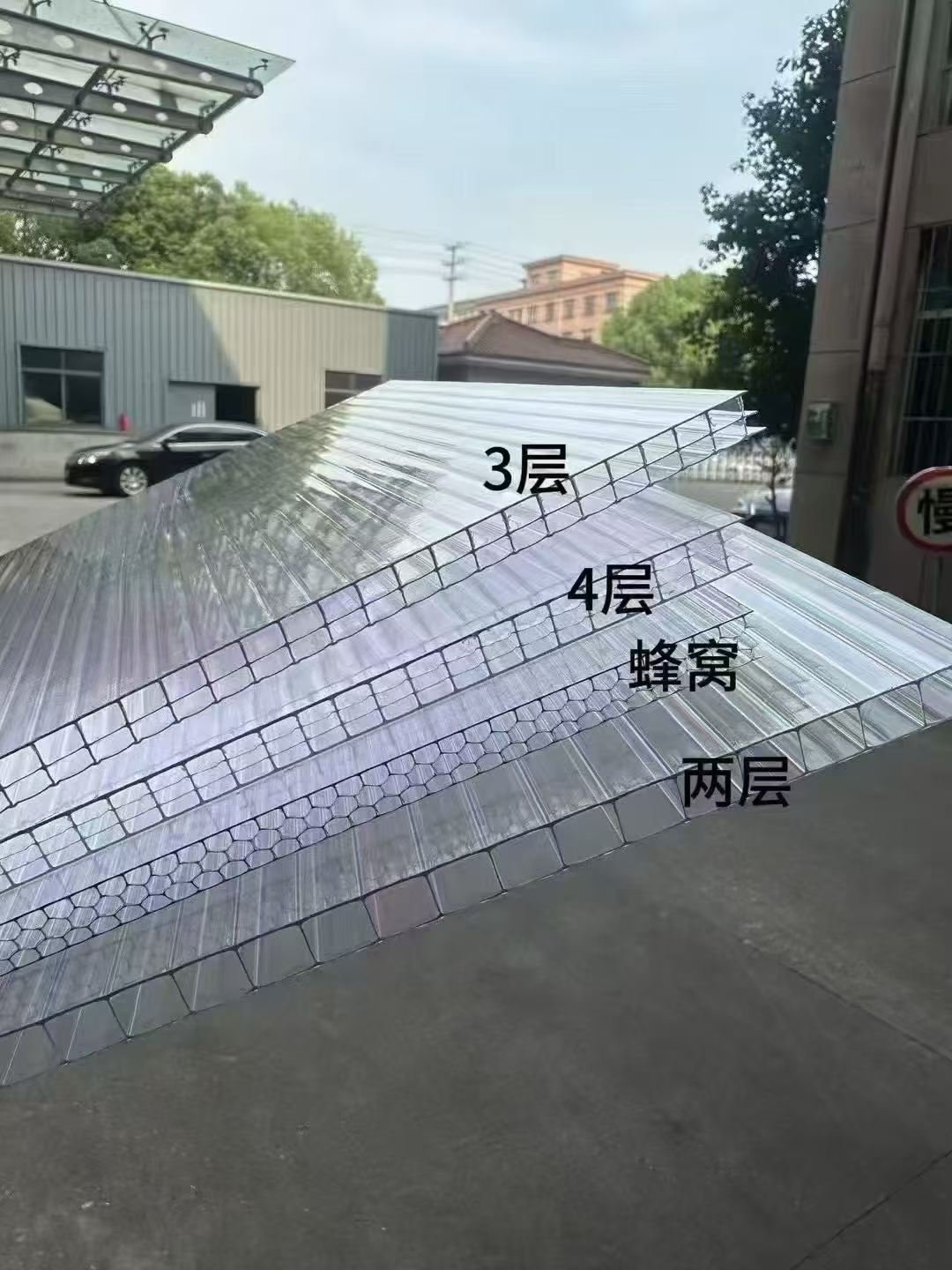
The linear thermal expansion coefficient (0.065 mm/m·°C) is the same for both multiwall and solid polycarbonate sheets. However, multiwall sheets may appear to buckle more visibly because their hollow structure is less rigid in the transverse direction.
Can I use silicone sealant to fill the expansion gap?
No. Filling the expansion gap with rigid sealant defeats its purpose. If edge sealing is needed, use a flexible, non-hardening sealant specifically designed for polycarbonate that remains elastic after curing. Even then, leave at least half the calculated gap unfilled.
What if the gap is slightly too large?
A gap slightly larger than recommended won’t cause problems — the sheet won’t rattle if properly fastened. Excessively large gaps (more than 2× the calculated value) may allow water ingress. Use rubber gaskets or edge trims to seal while maintaining flexibility.
Does UV coating affect thermal expansion?
No. The co-extruded UV protective layer is extremely thin (30–50 microns) and doesn’t affect the sheet’s thermal expansion behavior.
Get Expert Guidance
Proper installation is the difference between a polycarbonate sheet system that lasts 15+ years and one that fails in its first summer. If you’re planning a project and need specific recommendations for your climate and sheet dimensions, contact our team for a consultation — we’ll help you calculate the right gap, select the correct fasteners, and avoid costly installation mistakes.