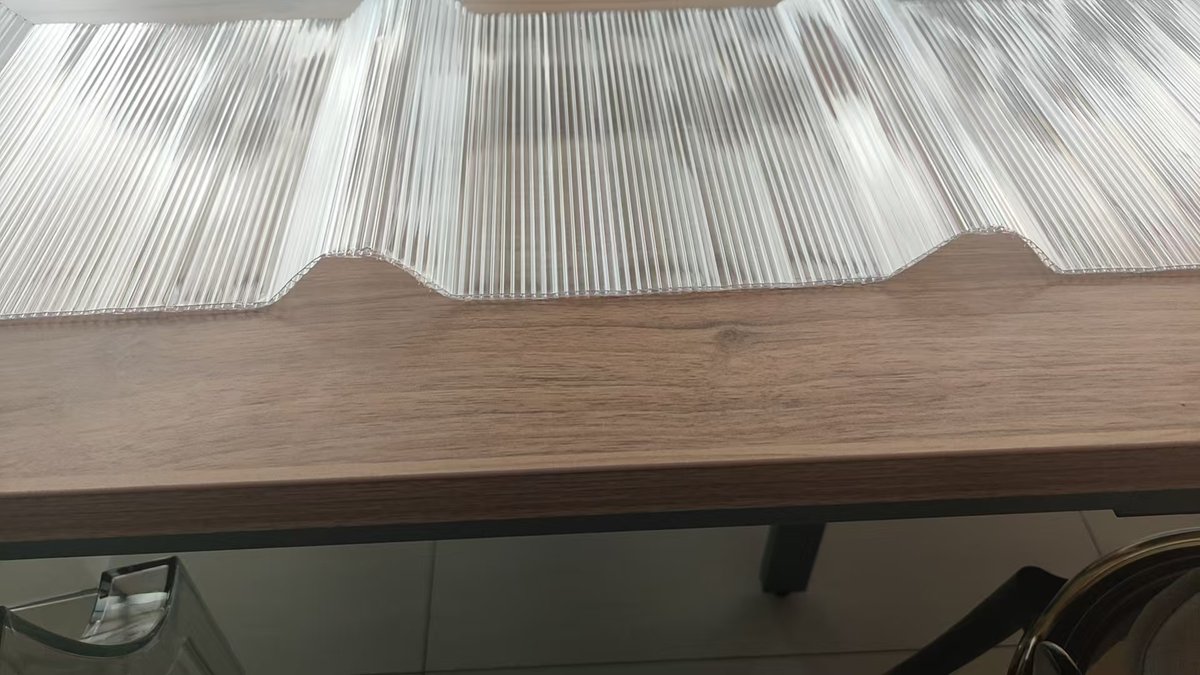
Bottom line: hollow corrugated polycarbonate sheet pairs a self-draining wave profile with a hollow multi-wall core, so one panel sheds rain and traps insulating air at the same time. It is produced 2–16 mm thick in effective widths from 840 mm to about 1114 mm, weighs 1.0–1.8 kg/m², and clear grades transmit up to 85% of daylight — the reason it is the standard glazing for insulated greenhouse roofs, livestock barns and light industrial canopies.
What hollow corrugated polycarbonate sheet is
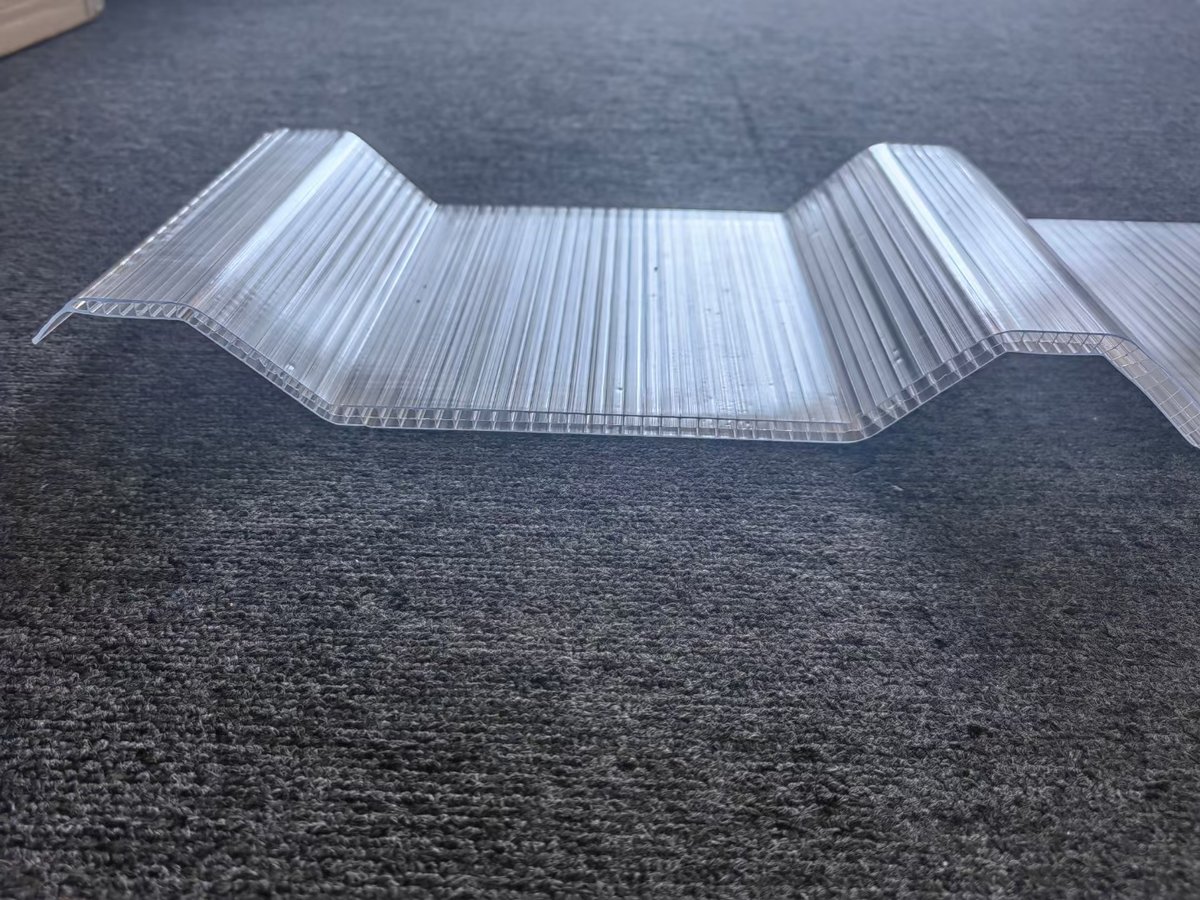
Hollow corrugated polycarbonate sheet (also called multi-wall corrugated PC sheet) is an extruded polycarbonate panel with two or more walls joined by internal ribs, formed into a continuous trapezoidal wave instead of a flat board. The wave profile gives the panel bending stiffness and lets overlapping sheets drain water, while the hollow core traps air between the skins to insulate and cut weight. Next to a solid corrugated sheet of the same thickness it is lighter and insulates better; next to a flat multiwall sheet it spans and drains on a roof without extra framing slope.
Complete specification range
As a manufacturer we extrude hollow corrugated polycarbonate to the industry-standard ranges below. Custom profiles, colours and cut-to-length panels are available on request.
| Parameter | Available range |
| Profile types | 840 / 900 / 930 / 950 / 1050 (domestic standard); 1080–1190 mm modular (international) |
| Thickness | 2–16 mm (2–3 mm thin-wall; 6–16 mm multi-wall) |
| Structure | Twin-wall (2-wall), triple-wall (3-wall), four-wall (4-wall) |
| Effective width | 840–1114 mm |
| Wave height | 18–55 mm |
| Wave pitch | 76–218 mm |
| Weight | 1.0–1.8 kg/m² |
| Light transmission | Clear ≈ 85%, opal ≈ 70%, green ≈ 60% |
| U-value | ≈ 4.5 W/m²·K (twin-wall) |
| UV protection | Co-extruded UV layer, ≈ 50 μm, one or both sides |
| Standard length | 6 m / 12 m, cut to order |
| Fire rating | B1 (GB 8624), UL94 V-0 to V-2 |
| Service temperature | −40 °C to +120 °C |
| Impact strength | ≈ 200× that of glass |
Profile types and dimensions
The profile is identified by its effective (installed) width and wave geometry. Domestic profiles follow the 840/900/930/950 series used for steel roof cladding, while international modular profiles run wider with taller waves for longer spans.
| Profile (effective width) | Wave height | Wave pitch | Typical thickness |
| 840 / 900 / 930 / 950 | 18–28 mm | 76–210 mm | 2–3 mm |
| 1050 / 1120 | 38–55 mm | 210–218 mm | 6–16 mm |
| 1080–1190 (modular) | 18–38 mm | 76–218 mm | 2–3 mm |
Weight by thickness
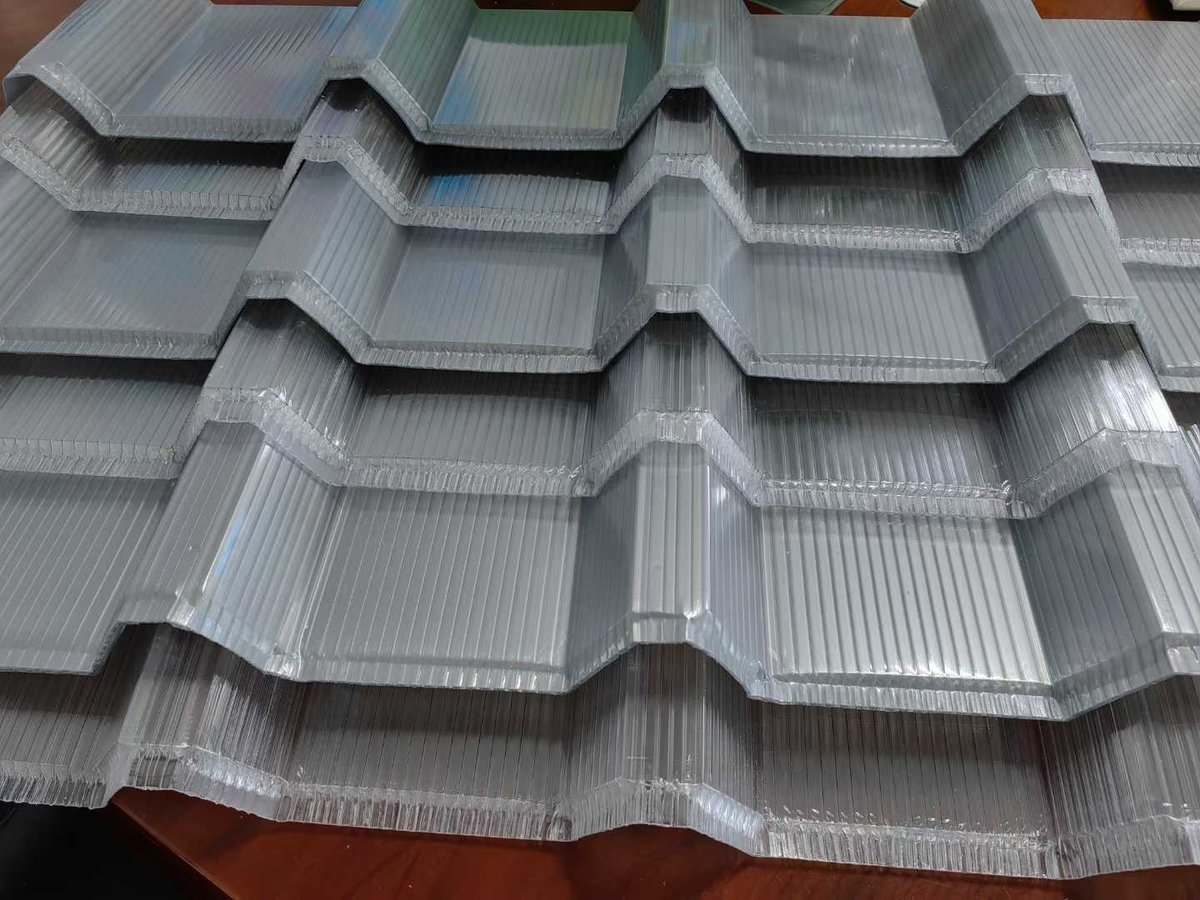
Hollow corrugated sheet stays light because the core is mostly air. Thin-wall profiles weigh about a third of an equivalent solid sheet.
| Thickness | Weight |
| 2.0 mm twin-wall | ≈ 1.10 kg/m² |
| 2.5 mm twin-wall | ≈ 1.25 kg/m² |
| 3.0 mm twin-wall | ≈ 1.40 kg/m² |
| 6–16 mm multi-wall | 1.5–3.5 kg/m² (by structure) |
Applications
Hollow corrugated polycarbonate sheet is specified wherever a roof must be light, insulated and self-draining. The most common uses are greenhouse and polytunnel roofs that keep warmth in, livestock and poultry barns where a translucent insulated roof cuts heating cost, and carports, walkways and light industrial canopies that need daylight without heavy steel. It is also used for partition walls and decorative cladding where the wave profile is part of the look.
Need a specific profile, thickness or colour for your project? Contact our team for a quote, samples and current lead times.
Frequently Asked Questions
What is the difference between hollow corrugated and solid corrugated polycarbonate sheet?
The hollow version has an internal multi-wall core with air chambers between its skins, while solid corrugated sheet is one solid wall. The hollow core cuts weight and adds insulation, so hollow corrugated panels are the lighter, better-insulating choice for insulated roofs; solid corrugated sheet is used where maximum stiffness or a lower profile is required.
What thickness should I choose for a greenhouse roof?
2–3 mm twin-wall corrugated sheet is the standard for unheated covers and small greenhouses. For heated greenhouses in cold regions, or where snow load and wider purlin spacing matter, step up to a thicker 6–16 mm multi-wall profile. Thickness should always be confirmed against local snow and wind load.
Does hollow corrugated polycarbonate sheet insulate well?
Yes. The trapped air chambers in the hollow core give the panel real thermal resistance — a thin twin-wall corrugated sheet has a U-value around 4.5 W/m²·K, noticeably better than single-layer glazing. Thicker multi-wall profiles insulate further.
How is hollow corrugated polycarbonate sheet fixed to a roof?
It is screwed through the wave crests with waterproof self-tapping screws and sealing washers into purlins, with overlaps along the side laps to shed water. A co-extruded UV face goes outward, and the sheets must be left free to expand and contract with temperature.
What profiles and widths are available?
Standard domestic profiles are 840, 900, 930, 950 and 1050 in effective width, with international modular profiles from about 1080 mm to 1190 mm. Wave height runs 18–55 mm and wave pitch 76–218 mm depending on the profile. Custom profiles and cut-to-length panels are available on request.